PEER REVIEW
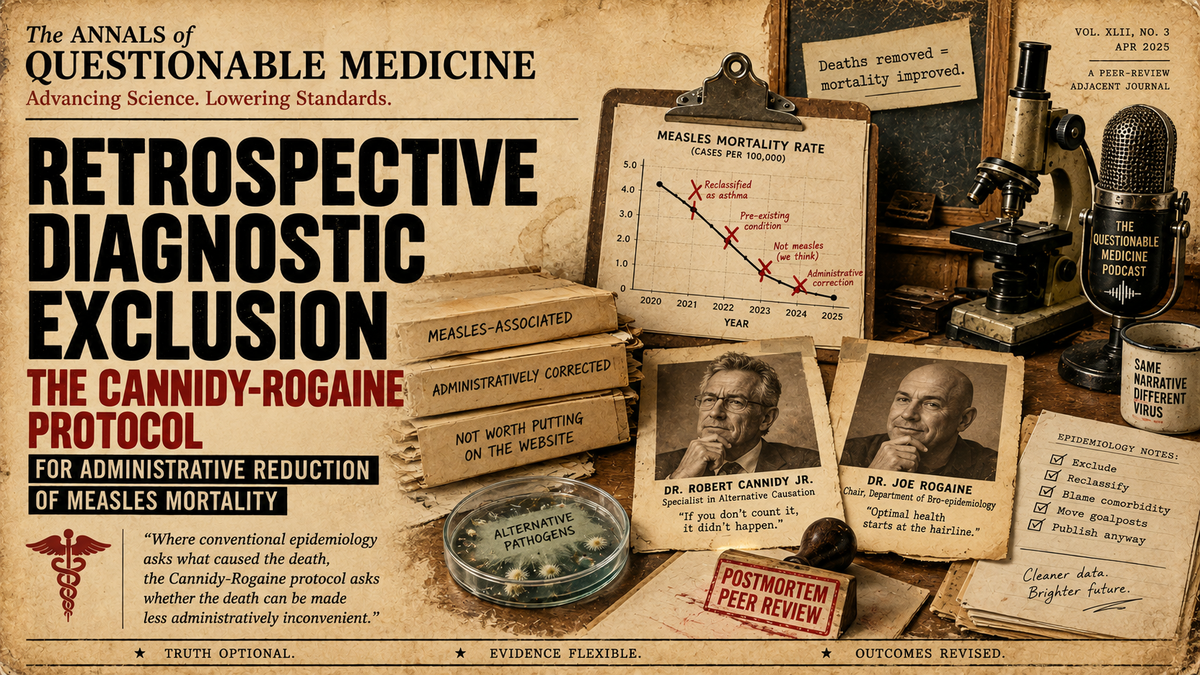
Retrospective Diagnostic Exclusion as a Public-Health Intervention: The Cannidy-Rogaine Protocol for Administrative Reduction of Measles Mortality
Objective: To determine whether mortality can be reduced after death by repeatedly narrowing the definition of what counts as a disease-associated fatality.
Methods: Investigators developed the Cannidy-Rogaine Postmortem Reclassification Protocol (CRPRP), under which every disease-associated death was examined for additional diagnoses, contributing conditions, unanswered questions, insufficiently agreeable terminology, or other opportunities for statistical liberation.
Results: Mortality declined in direct proportion to the number of deaths removed from the mortality dataset. The intervention achieved maximum efficacy whenever researchers were permitted to redefine the endpoint after observing it.
Conclusion: Unlike vaccination, definitional prophylaxis can be administered after death.
Background
For generations, epidemiologists have operated under the restrictive assumption that public-health statistics should describe public-health events. This methodology requires laboratories, clinicians, surveillance systems, epidemiologists, medical records, standardized definitions, and other expensive infrastructure capable of producing answers before senior officials know which answers would be most convenient.
The Cannidy-Rogaine model offers an important alternative.
“Where conventional epidemiology asks what caused the death, the Cannidy-Rogaine protocol asks whether the death can be made less administratively inconvenient.”
— Dr. Robert F. Cannidy Jr., fictional principal investigator
Under traditional epidemiological practice, the presence of multiple contributing conditions does not necessarily require investigators to pretend that all but one ceased to exist. The Cannidy-Rogaine Protocol identifies this as an unnecessary attachment to causality.
Under the revised framework, discovery of an additional medical condition progressively weakens every previously identified cause until sufficiently complicated patients can be understood to have died of nothing in particular.
This provides an important methodological advantage because most human beings possess more than one biological characteristic at the time of death.
Methods
Researchers conducted a retrospective, post-outcome, conclusion-aware observational reassessment using the Cannidy-Rogaine Postmortem Reclassification Protocol.
Each recorded disease-associated death underwent the following procedure:
Step 1. Determine whether infection had been documented.
Step 2. Search the medical history for another condition.
Step 3. If another condition exists, classify causation as uncertain.
Step 4. If causation remains plausible, search harder.
Step 5. If the disease continues appearing relevant, question the
definition of “associated.”
Step 6. If the case remains in the dataset, question the dataset.
Step 7. If the dataset resists reinterpretation, question the
institution maintaining it.
Step 8. Repeat until the desired public-health outcome is achieved.
No control group was required because controls occasionally produce uncontrolled conclusions.
Statistical significance was defined as p < politically inconvenient. Confidence intervals were replaced with confidence.
Primary Endpoint
The primary endpoint was the number of deaths remaining after deaths no longer meeting progressively revised criteria were removed.
Secondary Endpoints
Secondary outcomes included television-appearance survivability, podcast reproducibility, administrative comfort, reduction in troublesome numerators, and the ability to describe a settled observation as “unsettled” after personally unsettling it.
Selected Findings
| Observation | Cannidy-Rogaine Explanation | Peer Review Status |
|---|---|---|
| Patient had laboratory-confirmed measles | Suspiciously specific evidence requiring considerably broader context | Referred to podcast |
| Patient had another medical condition | Therefore measles could not meaningfully contribute | Accepted by unanimous author vote |
| Neurological complications followed infection | Temporal relationships are notoriously chronological | Under investigation |
| Patient was unvaccinated | Vaccination status introduces ideological confounding | Removed from abstract |
| Multiple clinicians considered measles relevant | Appeal to expertise | Rejected |
| State epidemiologists retained case in mortality statistics | Possible institutional bias toward counting | Administratively corrected |
| Death remained after exclusion criteria were applied | Exclusion criteria insufficiently exclusive | Protocol revised |
| Mortality declined after deaths were removed | Intervention successful | Press release issued |
Mechanism of Action
The Cannidy-Rogaine Protocol operates through a previously undescribed pathway known as Retrospective Outcome Modulation.
Unlike traditional medicine, which attempts to alter events before they happen, Retrospective Outcome Modulation changes what an event means afterward.
This provides several important logistical advantages.
Vaccines must be manufactured, transported, refrigerated, administered, monitored, and given before exposure.
Antiviral therapies require patients.
Hospital treatment requires hospitals.
Reclassification requires Microsoft Excel.
The resulting savings could substantially reduce the cost of public health, particularly if public health itself can subsequently be reclassified as an unnecessary expense.
Causal Dilution Theory
Cannidy and Rogaine further propose the Principle of Causal Dilution:
“When more than one factor contributes to an outcome, responsibility for each factor approaches zero.”
— Dr. Joe Rogaine, fictional co-investigator
Under this framework, a patient experiencing infection, pneumonia, dehydration, neurological complications, and cardiovascular stress has not experienced an especially complicated infectious illness.
The patient has simply accumulated excessive variables.
Removing sufficient variables therefore improves the outcome retrospectively.
The procedure resembles homeopathy, except the active ingredient being diluted is causation.
Discussion
Critics may argue that removing deaths from a dataset does not prevent deaths.
This objection reflects an outdated attachment to prospective chronology.
Modern administrative medicine recognizes that an outcome may be improved either by preventing the event or by improving the paperwork describing the event.
Indeed, retrospective classification offers an advantage unavailable to traditional prevention:
It cannot fail before the patient dies.
The researchers additionally observed that contradictory evidence strengthened the Cannidy-Rogaine hypothesis.
If epidemiologists agreed with the investigators, consensus had been achieved.
If epidemiologists disagreed, institutional resistance demonstrated the disruptive character of the methodology.
If independent replication failed, replication itself could be identified as politically compromised.
The resulting inferential sequence was therefore formalized as follows:
“Replication failed → replication was politically compromised → peer review became compromised → public disagreement demonstrated controversy → controversy demonstrated uncertainty → uncertainty justified reclassification.”
— Cannidy-Rogaine Recursive Evidence Model
Reviewers noted that this reasoning appeared circular.
The authors responded that circles contain no loose ends.
Limitations
Several limitations should be acknowledged.
First, deceased patients could not be successfully interviewed regarding whether they considered their deaths sufficiently disease-related.
Second, conventional epidemiologists continued applying standardized definitions despite being informed that those definitions were generating undesirable numbers.
Third, the present investigation cannot reliably distinguish between reducing mortality and reducing the number displayed next to the word “mortality.”
The investigators consider this distinction primarily semantic.
Conclusion
The Cannidy-Rogaine Postmortem Reclassification Protocol represents a promising frontier in administrative public health.
Rather than undertaking the difficult work of preventing infection, improving vaccination coverage, treating complications, maintaining surveillance systems, and measuring outcomes consistently, policymakers may achieve immediate statistical improvement by revisiting the definition of the outcome itself.
Future research should determine whether the protocol can be extended to cancer, infant mortality, occupational injuries, foodborne illness, highway fatalities, unemployment, inflation, and other phenomena whose continued measurement occasionally produces discouraging numbers.
The theoretical ceiling is extraordinary.
With sufficiently rigorous exclusion criteria, no American need ever die of anything again.
References
Pennsylvania Department of Health. (2026, September 16). Pennsylvania Department of Health provides statewide update on measles outbreak as cases reach 731 in 38 counties. Commonwealth of Pennsylvania. pa.gov
Reuters. (2026, September 3). Kennedy asked to remove Pennsylvania measles death from CDC tally, sources say. Reuters. reuters.com
Pennsylvania Department of Health. (2026, September 15). DOH confirms two additional measles-associated deaths. Commonwealth of Pennsylvania. pa.gov
Cannidy, R. F., Jr., & Rogaine, J. (2026). The Cannidy-Rogaine postmortem reclassification protocol: Removing mortality at the point of definition. Journal of Outcomes We Were Hoping For, 404(0), 0–0. Manuscript accepted before submission.