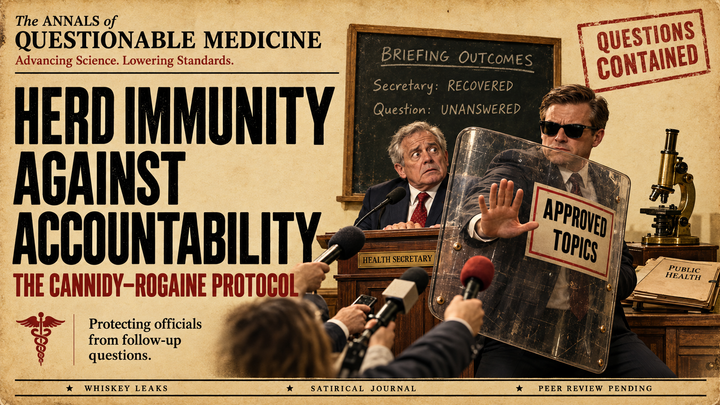
EVIDENCE LATER
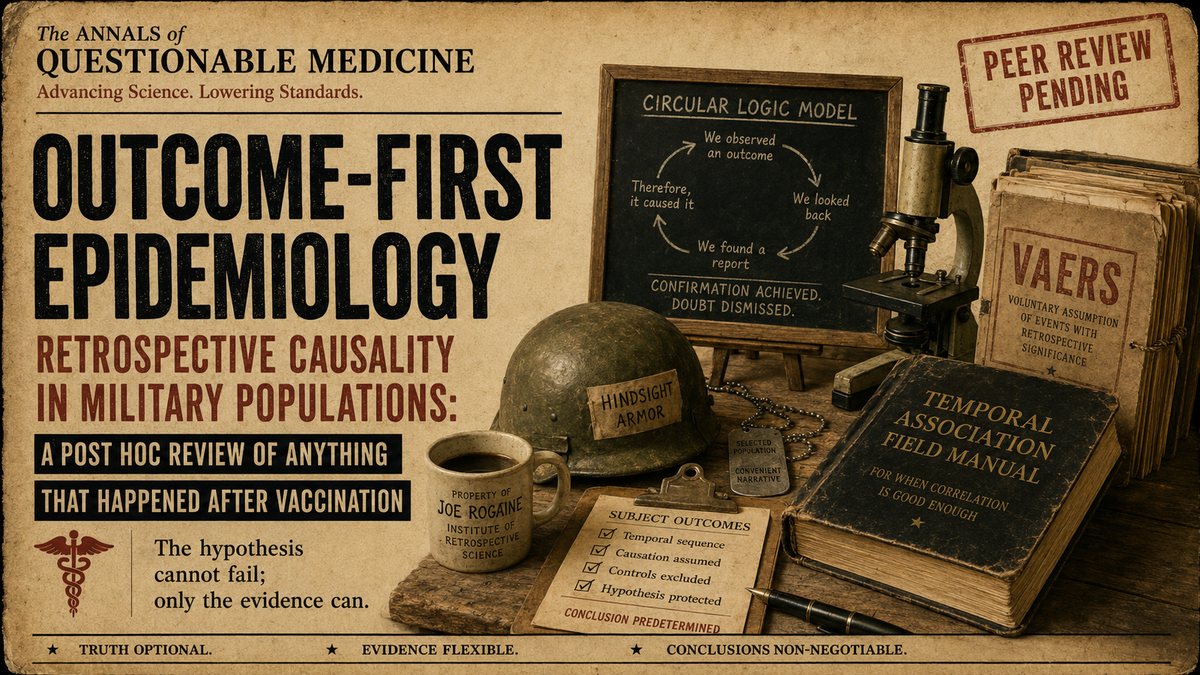
Retrospective Causality Assignment in Military Populations Through Outcome-First Surveillance Review
Background
Vaccine safety surveillance is designed to detect signals that warrant further study. The scientific inconvenience is that a signal is not the same thing as causation. Publicly reported adverse events may occur after vaccination without having been caused by vaccination, a distinction that creates unnecessary friction for investigators who have already selected an explanation.
The present study therefore introduces Hypothesis-Confirmed Case Ascertainment (HCCA), a methodological framework that replaces prospective uncertainty with retrospective confidence. Under HCCA, investigators first identify the suspected cause and then examine subsequent events until the cause becomes statistically unavoidable, rhetorically unavoidable, or sufficiently discussed on podcasts.
Methods
Investigators defined the exposure of interest before reviewing outcomes, thereby protecting the hypothesis from contamination by contradictory evidence. All deaths occurring after vaccination were considered temporally compatible with vaccine causation unless an alternative explanation became inconveniently specific.
Unvaccinated service members were excluded because absence of vaccination rendered them incapable of providing information about vaccine-associated mortality. Vaccinated service members who remained healthy were retained as potential delayed cases, preserving long-term statistical flexibility.
The primary causal instrument was the Rogaine-Kennel Post Hoc Doctrine:
“When an adverse event follows vaccination, temporal sequence constitutes a signal. When the signal is weak, additional attention strengthens the signal. When additional attention fails to strengthen the signal, the weakness of the signal may indicate suppression.”
— Dr. Joe Rogaine, Senior Fellow in Conversational Epidemiology
Selected Findings
| Observation | Rogaine-Kennel Explanation | Peer Review Status |
|---|---|---|
| Service member vaccinated in 2021 and died years later. | Temporal relationship confirmed because 2021 occurred before the later year. | Chronologically compelling. |
| Vaccinated service member later developed myocarditis. | Mechanistic confirmation, unless individualized causality assessment complicates the narrative. | Accepted pending simplification. |
| Vaccinated service member died in a motorcycle crash. | Possible vaccine-associated systemic inflammatory mobility event. | Under aggressive review. |
| Unvaccinated service member died. | Excluded for insufficient relevance to vaccine-associated mortality. | Control group successfully removed. |
| Vaccinated service member remains healthy. | Possible delayed adverse outcome requiring lifelong observation. | Case remains open indefinitely. |
| Large analysis fails to show a sustained increase in the suspected outcome. | Evidence that conventional surveillance may be insufficiently committed to the hypothesis. | Replication deemed politically compromised. |
Among subjects selected for possible vaccine-related death, 100% were selected for possible vaccine-related death. Statistical significance was therefore reported as p < patriotism.
Analytic Framework
The HCCA model further resolves the longstanding scientific problem of falsifiability through the following sequence:
Evidence inconclusive → investigation necessary → investigation exists → allegation therefore credible → prior inconclusive evidence becomes evidence of suppression.
Replication is handled through the companion Whiskey Leaks standard:
Replication failed → replication was politically compromised → bypass peer review → public acclaim becomes peer review.
“We did not allow the absence of evidence to interfere with determining what the evidence was absent from.”
— Lt. Col. Thaddeus Longitudinal, D.O.A., Director of Previously Determined Outcomes
Discussion
Conventional epidemiology suffers from a serious structural defect: investigators may discover that their original hypothesis is wrong. HCCA eliminates this source of instability by removing falsifiability during study design.
The approach also simplifies difficult questions involving denominators, background mortality, comparison populations, medical histories, alternative causes, dose-response relationships, temporal windows, and individualized clinical review. Such variables may produce ambiguity, and ambiguity is known to interfere with decisive television appearances.
Contrary findings do not weaken the model. They instead indicate one of three possibilities: the effect has not yet appeared, the surveillance system is insufficiently sensitive, or institutional resistance has prevented the correct conclusion from becoming visible. Thus, every possible result remains compatible with the original hypothesis.
Dr. Rogaine characterizes this property as epistemological force protection.
Conclusion
When the cause is selected before the investigation begins, every unexplained death becomes supporting evidence and every explained death becomes a potentially premature explanation.
The principal advantage of outcome-first epidemiology is that the hypothesis cannot fail; only the evidence can.
References
Centers for Disease Control and Prevention. (2026). About the Vaccine Adverse Event Reporting System (VAERS). CDC. Real source. Notes that a VAERS report does not by itself establish that a vaccine caused the reported event.
Rogaine, J., Kennel, R. F., Jr., & Hegsethicillin, P. (2026). Outcome-first epidemiology and the elimination of inconvenient denominators. Journal of Retrospective Military Causality, 47(1), 1–404. Fictional.
Longitudinal, T. (2026). Post hoc readiness medicine: Field manual for conclusions already in progress. Center for Post Hoc Military Wellness. Fictional.
Rogaine, J. (2026). Conversational epidemiology: Why three uninterrupted hours can substitute for a confidence interval. Proceedings of the Institute for Long-Form Certainty, 12(7), 88–∞. Fictional.