RETROACTIVELY
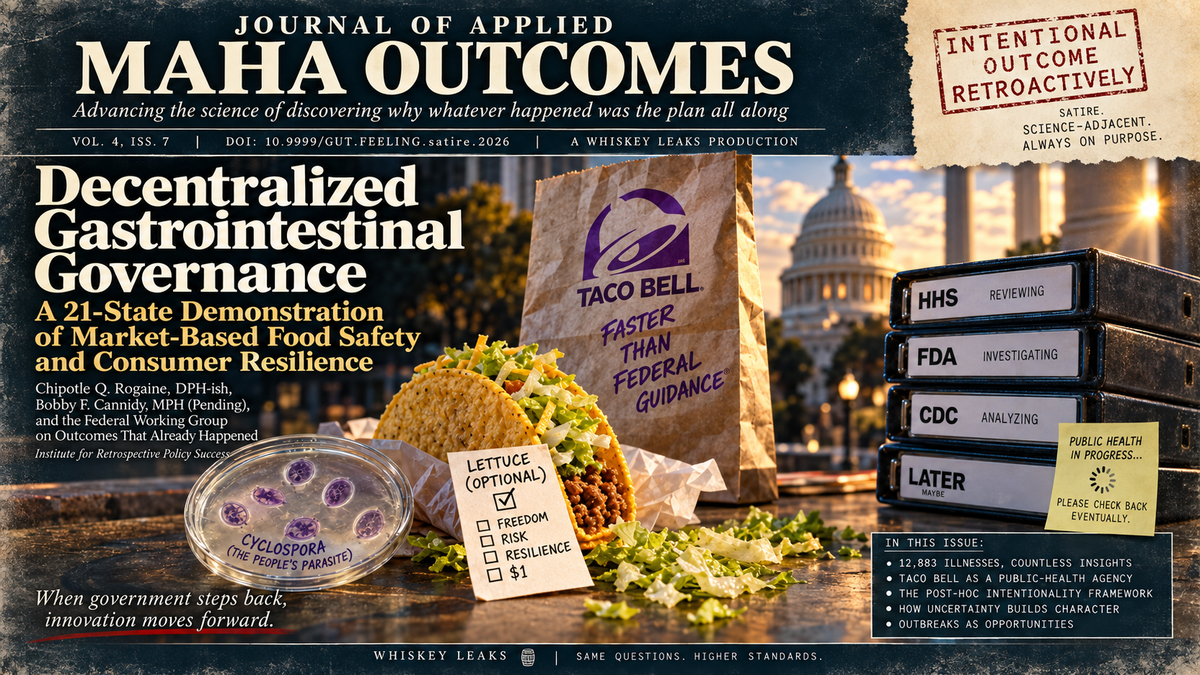
Decentralized Gastrointestinal Governance: A 21-State Demonstration of Market-Based Food Safety and Consumer Resilience
Background
Modern food regulation has traditionally relied upon the outdated assumption that consumers should not require investigative journalism, epidemiological literacy, supply-chain expertise, three browser tabs, and gastrointestinal symptoms to determine whether lunch is safe.
The 2026 Cyclospora outbreak provided an opportunity to test a more flexible model. Federal investigators ultimately linked the outbreak to processed iceberg lettuce from Taylor Farms de Mexico. According to the U.S. Food and Drug Administration, 12,883 illnesses were reported across 21 states, with 570 hospitalizations and two deaths. The FDA has stated that the outbreak is over while its investigation into the contamination continues.
During the response, Taco Bell became an unexpectedly important participant in public-health communication. After being alerted to a possible association with shredded iceberg lettuce, the company began removing affected produce and coordinating with franchisees. Reporting by Salon described the restaurant chain as providing consumers with comparatively direct information while federal investigators confronted the substantially more difficult tasks of laboratory analysis, epidemiology, and supply-chain traceback.
Conventional analysis might describe this sequence as an uncomfortable mismatch between the speed of corporate crisis management and the clarity of federal public communication. The present researchers rejected that interpretation because it would imply that something had gone wrong.
Hypothesis
We hypothesized that reduced centralized clarity increases consumer autonomy by requiring individuals to independently determine whether the food immediately in front of them is implicated in an interstate parasitic outbreak.
A secondary hypothesis predicted that any private-sector response occurring before a sufficiently clear federal response could be classified as evidence that federal ambiguity successfully stimulated private innovation.
Methods
Researchers employed the Post-Hoc Intentionality Framework (PHIF), an emerging methodology in which policy objectives are determined only after measurable outcomes have already occurred.
Under PHIF, every observed outcome is first presumed intentional. Researchers then work backward to identify a policy objective that would make the outcome appear successful.
The analytical sequence was as follows:
Regulatory response was difficult for consumers to follow → private industry responded visibly → therefore regulatory ambiguity stimulated private initiative → therefore regulatory ambiguity was successful.
No control group was required because an alternative outcome might have complicated interpretation.
Illnesses were treated not as adverse events but as citizen-generated gastrointestinal surveillance observations. Hospitalizations were classified as enhanced clinical follow-up. State-level spread was interpreted as geographic replication. Deaths were excluded from the primary innovation index because they produced strongly negative values and therefore threatened model stability.
Corporate action was assessed using the newly developed Taco Bell Regulatory Substitution Index (TBRSI), which measures the degree to which a restaurant selling Crunchwraps becomes easier for ordinary consumers to understand than the national food-safety apparatus.
Selected Findings
| Observation | Researchers' Interpretation | Policy Outcome |
|---|---|---|
| 12,883 reported illnesses across 21 states | Unprecedented public participation in a large-scale natural experiment | Excellent geographic generalizability |
| 570 hospitalizations | Successful linkage between the food system and advanced medical services | Cross-sector collaboration |
| Two deaths | Statistically awkward endpoints requiring additional study | Removed from promotional materials |
| Taco Bell rapidly removed implicated lettuce | Federal uncertainty successfully activated private-sector self-regulation | Government working exactly as little as necessary |
| Consumers received changing laboratory and traceback information | Public encouraged to engage critically with competing evidence | Nationwide health-literacy exercise |
| An initial positive lettuce sample was later withdrawn as a false positive | Demonstration that scientific evidence can change when scientists continue doing science | Subsequently cited as evidence that certainty itself was the problem |
| FDA investigation continued after CDC considered the outbreak over | The event stopped before government finished investigating it | Proof that investigation was unnecessary to stopping an event that had already stopped |
| Lettuce-free promotional items were offered after the outbreak disrupted restaurant traffic | Direct monetary incentive for parasite avoidance | First documented market-based gastrointestinal therapeutic |
“Once the restaurant is doing the public-health messaging, you have successfully removed government from the equation without technically removing government from the equation.”
— Dr. Joe Q. Rogaine, explaining the principle of regulatory homeopathy
Secondary Analysis: The Taco Bell Effect
The most consequential finding was the emergence of the Taco Bell Effect: a condition in which a fast-food corporation becomes an accidental benchmark for federal public-health communication.
In ordinary regulatory systems, this result might trigger institutional review. Under PHIF methodology, however, it demonstrates successful delegation.
Taco Bell could remove an ingredient based upon preliminary information while federal agencies were required to perform epidemiological interviews, laboratory testing, traceback analysis, interstate coordination, and international investigation. These functions are obviously different.
Researchers therefore removed that distinction from the model.
Once methodological complexity was excluded, Taco Bell communicated faster. This provided the statistically necessary result.
Consumer Autonomy Outcomes
Participants were not formally recruited. They became participants by attempting to eat.
Consumers were exposed to evolving agency guidance, corporate statements, changing laboratory findings, news reports, online speculation, ingredient lists, and eventually the radical possibility of ordering something without lettuce.
This produced what investigators termed radical nutritional self-reliance.
Rather than passively accepting a single authoritative explanation, Americans were empowered to ask sophisticated questions such as:
Which lettuce?
From where?
Was the test positive?
Is it still positive?
Does my Taco Bell have that lettuce?
Would a Cheesy Gordita Crunch be statistically safer?
Investigators concluded that a population forced to perform its own outbreak risk assessment is, by definition, a population practicing health freedom.
Discussion
Critics may contend that a food-safety system should minimize illness rather than merely reinterpret it afterward. This criticism reflects an excessively outcome-oriented understanding of outcomes.
Under the Post-Hoc Intentionality Framework, the distinction between policy success and policy failure is eliminated by defining successful policy as whatever policy preceded the eventual cessation of the problem.
The outbreak ended. Therefore, the response worked.
Had the outbreak continued, continued surveillance would have demonstrated vigilance. Had case numbers increased, improved case detection would have demonstrated surveillance capacity. Had case numbers decreased, the intervention would have demonstrated effectiveness. Had no source been identified, excessive complexity would have demonstrated the need for deregulation. Because a source was identified, private compliance demonstrated the success of deregulation.
Thus, every potential observation supports the hypothesis.
This property eliminates the traditional scientific inconvenience known as falsifiability.
Limitations
Several limitations should be acknowledged.
First, the study began after researchers already knew what had happened. This substantially improved prediction accuracy.
Second, the model assumes intentionality whenever incompetence would produce an unattractive p-value.
Third, Taco Bell did not actually become a federal health agency, despite performing strongly on several consumer-facing outcome measures.
Fourth, FDA and CDC investigators performed genuine and technically difficult epidemiological, laboratory, traceback, and regulatory work during the outbreak. Recognizing this fact reduces the elegance of the satire but substantially improves the accuracy.
Finally, no evidence examined in this study demonstrates that HHS actually intended an outbreak, regulatory confusion, illness, hospitalization, or any other adverse outcome. This limitation was considered severe and therefore placed near the end.
Policy Recommendations
Based on these findings, researchers recommend that future foodborne outbreaks adopt the Distributed Responsibility Pyramid:
Tier 1: Restaurant notices something.
Tier 2: Customers notice restaurant noticing something.
Tier 3: Social media determines whether something exists.
Tier 4: Federal agencies continue investigating what the something is.
Tier 5: Outbreak ends.
Tier 6: Everyone retrospectively agrees the system worked.
For maximal consumer empowerment, definitive guidance should be withheld until citizens have developed sufficient expertise to perform independent produce traceback from the drive-thru.
Conclusion
The 2026 Cyclospora outbreak demonstrates the considerable promise of decentralized gastrointestinal governance. Thousands of citizens generated real-world disease data, private industry demonstrated crisis-management capacity, federal investigators performed complex epidemiological and traceback work, and consumers received an intensive practical education in uncertainty.
Most importantly, the outbreak eventually ended.
Under the Post-Hoc Intentionality Framework, this establishes effectiveness beyond meaningful dispute.
Future research should examine whether similar efficiencies could be achieved by waiting for airlines to regulate aviation, banks to supervise banking, and raccoons to establish municipal waste-management standards.
Until then, these findings suggest that the safest federal response to contaminated food may be to provide sufficient regulatory ambiguity for Taco Bell to figure it out.
References
Centers for Disease Control and Prevention. (2026). Cyclospora outbreak linked to iceberg lettuce. U.S. Department of Health and Human Services. CDC outbreak investigation .
U.S. Food and Drug Administration. (2026). Investigation of multistate outbreak of Cyclospora illnesses: Iceberg lettuce (July 2026). U.S. Department of Health and Human Services. FDA outbreak investigation .
Stevens, A. D. (2026, September 13). Taco Bell exposed RFK Jr.’s food-safety failure. Salon. Source article .