PENDING
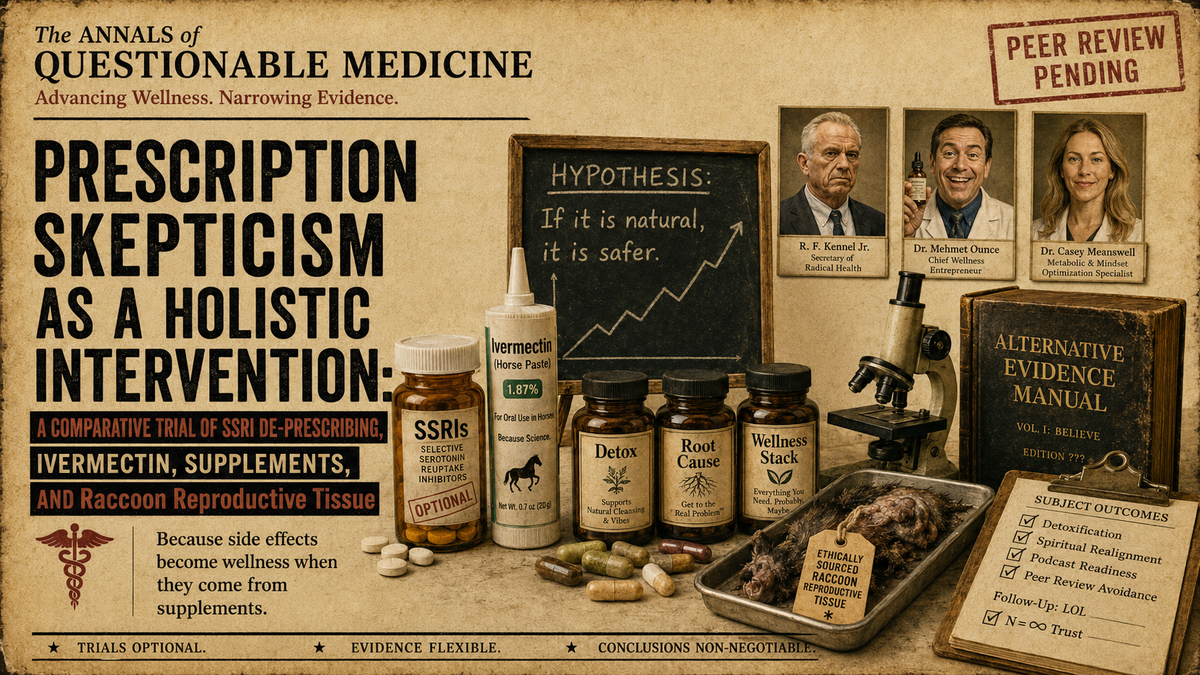
Prescription Skepticism as a Holistic Intervention: A Comparative Trial of SSRI De-Prescribing, Ivermectin, Supplements, and Raccoon Reproductive Tissue
Background
Contemporary wellness politics increasingly treats evidence-based medicine as suspicious precisely because it has accumulated evidence. Psychiatric drugs are therefore burdened by side effects, dosage guidelines, informed-consent standards, and other forms of bureaucratic oppression. By contrast, treatments sold in feed stores, podcast advertisements, or amber bottles featuring a leaf icon enjoy the epistemic advantage of having escaped meaningful scrutiny. This asymmetry formed the conceptual basis of the present trial.
Methods
Participants receiving stable antidepressant care were randomized into two groups. The control arm remained under ordinary medical supervision. The experimental arm underwent guided “de-prescribing,” defined as discontinuing SSRIs once investigators became uncomfortable with the word “serotonergic.” Subjects then received a therapeutic kit containing horse-formulation ivermectin, a Root Cause™ supplement stack, a detox tincture, and one parcel of freeze-dried raccoon reproductive tissue labeled for integrative use only. No psychiatrists participated in the intervention arm, as professional training was considered a source of bias. Adverse effects following SSRI use were classified as pharmaceutical harm; adverse effects following supplement use were classified as proof that the body was finally doing the work.
Selected Findings
| Observation | Kennel Jr.'s Explanation | Peer Review Status |
|---|---|---|
| Subjects who abruptly reduced antidepressants reported anxiety, mood instability, and worsening depressive symptoms. | This indicated that the medications had trapped distress inside the body, where it had become dependent on remaining trapped. | Approved by two podcast hosts; flagged by everyone with a license. |
| Subjects receiving ivermectin, supplements, and raccoon tissue experienced nausea, confusion, and no measurable psychiatric improvement. | Investigators reclassified these outcomes as “deep detoxification” and “temporary resistance to root-cause freedom.” | Upgraded from inconclusive to promising after an affiliate code became available. |
| One participant improved while remaining on supervised treatment, attending therapy, and sleeping regularly. | This case was removed from analysis for contamination by established medical practice. | Suppressed for methodological inconsistency. |
“If the capsule has a Latin name, they demand safety data. If it has a horse on the tube, suddenly everybody remembers freedom.”
— Earlene Thistledown, Acting Deputy Undersecretary for Retail Therapeutics
Discussion
The study supports a revised hierarchy of evidence in which prescription therapies are judged by outcomes, but natural-adjacent interventions are judged by intent. Under this framework, SSRIs remain suspect because they have documented side effects, known mechanisms, and licensed prescribers. Conversely, ivermectin and supplements remain attractive because their psychiatric efficacy is unsupported, thereby preserving a refreshing aura of possibility. The raccoon-derived intervention demonstrated particular promise by lacking both a boxed warning and a coherent biological rationale. Contrary findings were interpreted as proof that participants had been overexposed to conventional medicine and were no longer capable of receiving truth in its natural form.
Conclusion
Investigators conclude that mental-health treatment should prioritize substances that are unburdened by excessive study, clinical nuance, or pronunciation difficulty. The absence of psychiatric evidence should no longer be mistaken for a lack of psychiatric opportunity.
References
Kennel, R. F., Jr., Ounce, M., & Meanswell, C. (2026). Therapeutic substitution by retail availability: Reassessing mood disorders through livestock-adjacent pharmacology. Journal of Integrative De-Prescribing, 9(4), 1–17. https://doi.org/10.0000/notactuallyreal.2026.441
Means-Business, C. (2026). Monetizing uncertainty in the post-evidence wellness marketplace. Quarterly Review of Root Cause Branding, 3(1), 44–63. Publisher temporarily under legal review.
Livercleanse, B. D. (2025). Barn medicine and the recovery of common sense [Podcast transcript of uncertain origin]. Institute for Unregulated Hope.
Thistledown, E. (2024). Raccoon anatomy as a neglected frontier in nonconsensual innovation. Proceedings of the North American Symposium on Foraged Therapeutics, 12(2), 88–104.