
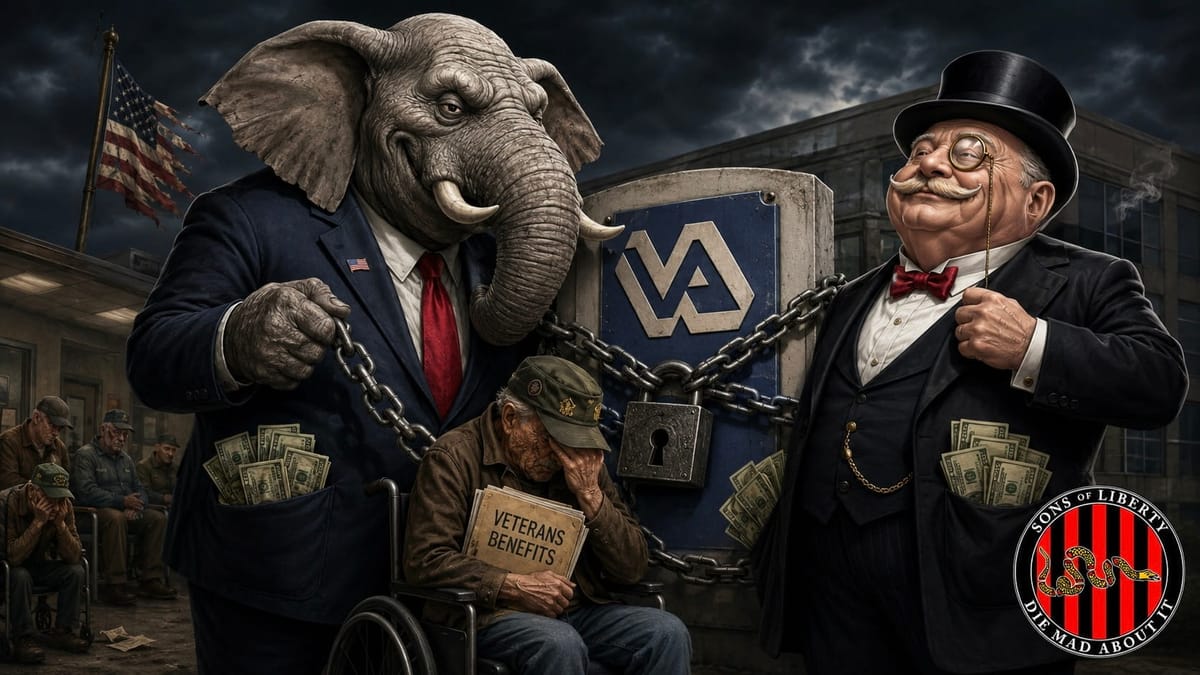
Who’s Going to Think of the Wealthiest?
Dan Crenshaw lectures veterans about “victimhood” while his party protects dependency at the very top.
Dan Crenshaw has decided that the Veterans of Foreign Wars is perpetuating a “veteran victimhood narrative.”
That is one hell of a sentence from a medically retired combat veteran aimed at an organization representing men and women who served in foreign wars.
The VFW supported the Major Richard Star Act. It supported expanding benefits for combat-injured veterans and surviving families. What it refused to support was a legislative shell game that helped one group of veterans by reducing future disability compensation for another.
Crenshaw’s response was not to attack the people who designed that rotten trade. He attacked the veterans who would not accept it.
Read the report Crenshaw attacks veterans groups over disability-benefit fight Raw Story · Opens in a new tabCongress put one group of veterans on the table and told another group to bring the knife. The VFW refused. Crenshaw got mad at the wrong people.
Let’s be precise. Nobody is questioning Dan Crenshaw’s service. Nobody is questioning the eye he lost in Afghanistan. Nobody is questioning his right to the benefits he earned.
That is the courtesy he should extend to everyone else.
Instead, he looked at a congressionally chartered veterans organization objecting to future cuts and called it victimhood. He accused the VFW of screwing veterans because it would not bless a deal that redirected projected savings from tinnitus and sleep-apnea compensation into other veterans programs.
That is not solidarity. It is hostage-taking with a flag pin.
Pass the Major Richard Star Act. Fund it honestly. Do not tell one wounded veteran that his benefit depends on Congress narrowing the claim of the next one.
Veterans did not force Congress to bundle a popular benefit with future compensation cuts. Lawmakers did that. Blaming the VFW for refusing the bargain is blaming the hostage for noticing the gun.
Crenshaw likes the word victimhood. Fine. Let’s examine dependency and grievance across the entire economy instead of reserving the sermon for people with damaged hearing, wrecked joints, PTSD, traumatic brain injuries, and sleep disorders.
Why does the Republican Party never ask whether decades of tax preferences, preferential rates, subsidies, bailouts, inherited wealth, government contracts, protected monopolies, and estate-tax giveaways have created dependency at the top?
Where is the stern lecture about personal responsibility when a billionaire demands another tax cut?
Where is the warning about learned helplessness when a defense contractor cannot survive without a federal procurement pipeline?
Where is the outrage when a private-equity firm strips a company, loads it with debt, lays off the workers, and walks away with the fees?
Who’s going to think of the wealthiest?Apparently, the entire Republican Party
We hear endlessly about dependency when the recipient is poor, disabled, unemployed, or wearing a VA-issued hearing aid.
When the recipient owns a hedge fund, dependency becomes “investment.”
When the recipient manufactures missiles, dependency becomes “readiness.”
When the recipient inherited enough money to buy a senator, dependency becomes “success.”
That is not fiscal conservatism. It is welfare chauvinism. The money is only shameful when it flows downhill.
Veterans did not suddenly become less honorable. Disability claims did not suddenly become a moral contagion. The wars are simply far enough behind us that the political bill has become easier to resent than the politicians who created it.
For twenty years, Washington used the all-volunteer force like a tool that could be sent back to the garage after every deployment. Iraq was launched by George W. Bush’s Republican administration. Afghanistan became a generation-long bipartisan failure. The same relatively small population went back again and again while most Americans went shopping.
Now the invoice is arriving through VA compensation, healthcare, caregiver support, toxic-exposure claims, mental-health treatment, and decades of long-term care.
Suddenly the language changes.
Project 2025 did not invent this instinct, but it put the machinery on paper: tighten disability eligibility, accelerate rating revisions, expand privatization, consolidate facilities, and subject the VA workforce to greater political control.
Primary document Project 2025: Mandate for Leadership Heritage Foundation · Full PDFThe public sales pitch will never be “we are coming for veterans.” It will be efficiency, modernization, fraud prevention, choice, accountability, or some other polished little phrase carrying a crowbar behind its back.
The first move is always the same: separate the “deserving” veteran from the suspicious one.
Combat from support. Visible wounds from invisible ones. The amputee from the veteran with tinnitus. The infantryman from the cook. The veteran who filed immediately from the one who needed ten years to admit something was wrong.
Once the categories are established, the cuts can begin.
And now Donald Trump has entered another voluntary conflict with Iran, a war he has not clearly won and has not successfully negotiated his way out of.
The Pentagon will get its supplemental. The intelligence agencies will get theirs. The contractors will submit invoices with the serene confidence of men who know nobody will ask whether a cruise missile has developed a dependency problem.
Current funding fight House Republicans advance additional Iran-war and defense funding Reuters · July 16, 2026What will the GOP propose for the Pentagon’s future medical bill?
More staffing for military hospitals?
More mental-health capacity?
More money for traumatic brain injuries, hearing loss, toxic exposure, rehabilitation, and family caregivers?
Or another tax cut for the wealthiest Americans, followed by another lecture about the cost of caring for the troops sent to fight the war?
The bombs are paid for immediately. The veterans are audited for decades.
Nobody asks Raytheon for a current diagnosis.
Nobody asks Lockheed Martin to document an in-service event.
Nobody demands a nexus letter from Northrop Grumman.
The contractor submits an invoice and gets paid.
The veteran submits a medical claim and gets treated like a thief.
That is the racket.
What did veterans do to deserve this?
We enlisted.
We deployed.
We followed lawful orders.
We absorbed the blasts, smoke, chemicals, fear, grief, injuries, and years that most of the country never had to surrender.
We did what the nation asked.
The offense, apparently, was surviving long enough to file the paperwork.
Fraud exists. Investigate it. Prosecute it. Shut down predatory claims mills and canned nexus-letter factories. Modernize rating criteria through evidence and medicine.
But stop using fraud as a fog machine around an ideological attack on earned benefits.
And stop calling veterans victims because they refuse to finance one another’s care by surrendering future claims.
No More Hostages
Dan Crenshaw should know better.
His wounds are not a punchline. His benefits are not charity. His service does not need to be relitigated by strangers.
Neither does anyone else’s.
If Congress wants to help combat-wounded retirees, pass the goddamned bill.
If Congress wants another war, fund the entire cost of it, including the human beings who will spend the next fifty years living with the consequences.
If Republicans want to preach about dependency, they can begin with the donor class forever lined up at the federal trough demanding tax preferences, public contracts, deregulation, bailouts, and protection from the consequences of their own decisions.
Do not ask veterans to pay for veterans while billionaires receive another dessert course. Do not call sacrifice “victimhood” after the invoice arrives. And do not start wars you are unwilling to pay for all the way home.
Sources and further reading
Raw Story: report on Crenshaw’s attack against the VFW and disability-benefit advocacy.
Spectrum News: detailed account of the bill, Section 108, the VFW objection, and the House leadership retreat.
Project 2025: the Heritage Foundation’s full policy blueprint.
Reuters: current Republican proposal for additional defense and Iran-war spending.
Reuters: background on the Republican tax and spending package enacted in 2025.