Civic Field Notes · 2026
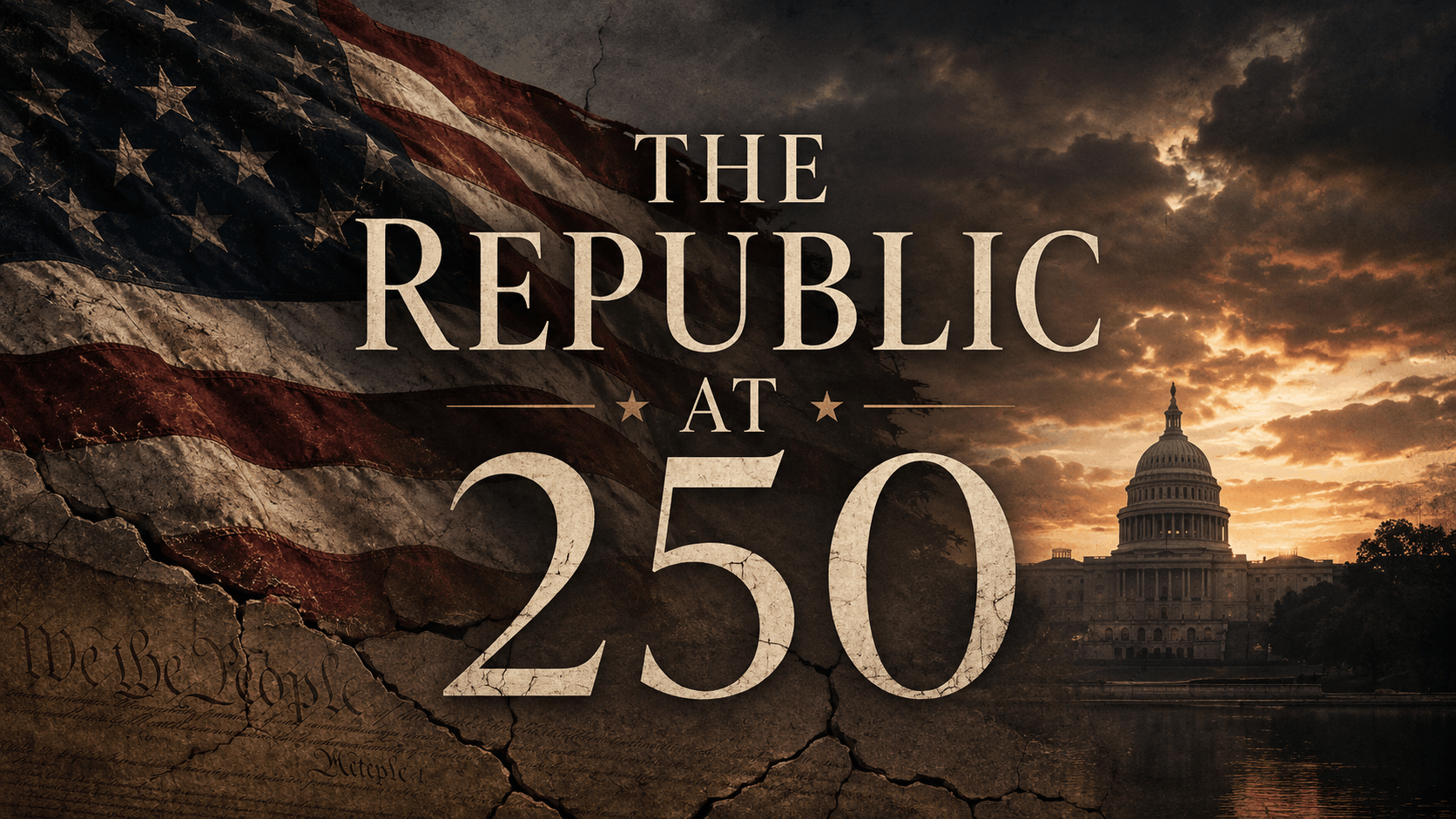
The Republic at 250
Who do we want to be when the country reaches its quarter-millennium: citizens, or an audience waiting to be ruled?
America is approaching its 250th birthday with all the furniture still in the house.
The Constitution remains. Elections are still held. Courts still issue opinions. Congress still meets beneath its painted ceiling. The flags are everywhere. The rituals continue.
And yet a country can preserve its furniture while the foundation begins to crack.
The danger facing the United States is not simply that one party may win too much, that one president may become too powerful, or that one foreign adversary may spread lies online. It is that several old dangers are beginning to reinforce one another: a governing class increasingly detached from ordinary life, a political culture consumed by faction, a public losing confidence in its own capacity to govern itself, and foreign powers eager to widen every existing fracture.
The Founders argued over all of these things. They did not agree. They were often wrong. They were also, at their best, painfully aware that liberty is not self-sustaining.
A capable Union, and the distance of power
Alexander Hamilton understood that a country cannot survive as a loose collection of jealous provinces. The Articles of Confederation had produced weakness, paralysis, debt, and a national government too feeble to meet national problems. A republic needed a federal government capable of acting, defending itself, enforcing law, and holding the Union together.
On that point, Hamilton was right.
But Melancton Smith, one of the more serious Anti-Federalist voices at New York’s ratifying convention, saw another danger. A powerful national government, he warned, could become socially distant from the people it governed. If representation became too narrow, too expensive, too polished, and too removed from ordinary life, government would be dominated by a natural aristocracy: people of wealth, standing, education, influence, and connection.
Smith did not argue that intelligence or competence were vices. Neither should we.
A serious country needs experts. It needs engineers, teachers, soldiers, doctors, scientists, administrators, lawyers, and public servants who know how to do difficult things. But expertise without social breadth becomes caste management. When the people making decisions have never faced ordinary vulnerability, they begin to govern vulnerability as an abstraction.
The mechanic becomes a statistic. The teacher becomes a budget line. The veteran becomes a talking point. The renter becomes a market condition. The family one missed paycheck from disaster becomes a demographic segment.
That is how a republic becomes a de facto oligarchy without ever declaring itself one.
The Constitution remains. The voting booths remain. Citizens are still invited to choose among candidates. But the menu is increasingly designed by donor networks, consultants, lobbyists, wealthy families, corporate boards, media ecosystems, think tanks, party operatives, and professional climbers who have learned that access is more durable than principle.
Ordinary Americans are still allowed into the process. They simply arrive near the end of it.
They are asked to cheer, donate, vote, repost, rage, and defend. They are asked to serve as proof that someone else’s political machine has “real people” behind it. But too often they are not invited into the rooms where the rules are written, the priorities are chosen, and the rewards are distributed.
This is not an argument against national power. Weak government has its own victims. A government unable to defend elections, enforce civil rights, regulate powerful interests, maintain infrastructure, or defend the country is not a tribute to freedom. It is merely an abandoned workshop where the strongest people take what they want.
The question is whether national power still belongs to a republic, or whether it has become the property of competing courts.
When ambition stops checking ambition
James Madison believed the constitutional system could restrain power by setting ambition against ambition. The branches of government would defend their own authority. Congress would resist executive overreach. Courts would protect law against temporary passions. Institutions would not be perfect, but they would compete enough to prevent any one person or faction from becoming supreme.
But what happens when ambition fails to curb ambition?
What happens when officials stop defending their institutions because their party controls them? When Congress becomes a cheering section for the presidency? When courts are treated as partisan weapons? When agencies become spoils, oversight becomes betrayal, and loyalty to a leader outranks loyalty to an oath?
Then ambition does not counteract ambition. It becomes a cartel.
The safeguards of the Constitution do not disappear in a dramatic coup. They become ceremonial. The forms remain, but the spirit drains out through the floorboards.
Faction, foreign influence, and hybrid warfare
George Washington saw the next danger before the republic was even fully grown. He warned that political parties could become engines by which ambitious and unprincipled men would divide the country, inflame suspicion, weaken public administration, and turn citizens against one another. He feared that party passions would make Americans easier to manipulate, including by foreign powers.
Washington’s warning deserves to be read with modern eyes.
Foreign influence does not always arrive in uniform. It can arrive through flattery, propaganda, conspiracy, manufactured outrage, selective leaks, viral lies, anonymous accounts, friendly influencers, and narratives designed to make Americans hate one another more than they love the country they share.
Vladimir Putin did not create America’s divisions. Russia did not invent our racial wounds, class resentments, political vanity, distrust of institutions, or appetite for spectacle. But Russian influence operations have sought to exploit those weaknesses, undermine confidence in elections, and deepen division among Americans.
That is the logic of hybrid warfare.
It does not need to conquer a country. It does not need to destroy every institution. It only needs to persuade enough citizens that democracy is fake, compromise is treason, every election is stolen unless their side wins, allies are parasites, expertise is corruption, and only one strong leader can restore order.
That is how a free people begin to invite despotism into the house.
Carter’s crisis of confidence
But hybrid warfare succeeds only where a deeper weakness already exists.
The threat is often nearly invisible in ordinary life. It is not only a crisis of elections, institutions, or national security. It is a crisis of confidence: confidence in the future, in one another, and in the ability of ordinary citizens to remain the ultimate rulers and shapers of their own democracy.
Jimmy Carter saw this in 1979.
He warned that Americans were losing faith not only in government, but in themselves. They were beginning to doubt whether public life was worth the effort, whether institutions could be repaired, whether sacrifice had meaning, and whether the future could be better than the past.
He was mocked for it. The speech became known as the “malaise” address, even though he never used the word. It was treated as gloomy, defeatist, and politically foolish.
In truth, Carter was not wrong. He was early.
He saw that a democracy hollowed out by consumption, cynicism, and self-interest would eventually lose the confidence needed to govern itself. He understood that people who no longer believe they can shape their country will look for someone else to shape it for them.
Carter’s failure was not that he misunderstood America. It was that he believed Americans still wanted to hear the truth.
He warned that citizenship required discipline, sacrifice, purpose, and responsibility. The country answered by choosing a more comforting lie: that the problem was never us. It was always the liberals, the conservatives, immigrants, unions, corporations, welfare recipients, the press, bureaucrats, foreigners, or whoever else could be made to carry the blame.
Carter asked Americans to grow up.
The country chose a salesman who promised that adulthood was optional.
A country does not lose its freedom only when its laws are repealed. It can lose it when citizens stop believing that public life is worth the effort. When every institution seems corrupt, every problem seems rigged, every neighbor becomes suspect, and the future feels smaller than the past.
That is the emotional terrain on which oligarchy, faction, foreign influence, and strongman politics thrive.
A healthy republic cannot survive on consumption alone. It cannot ask its citizens to measure success only by what they own, what they display, what they can buy, or how loudly they can perform their anger online. Material security matters. Economic dignity matters. But a life built only around acquisition eventually leaves a public vacuum behind it.
That vacuum does not remain empty for long.
It fills with grievance, spectacle, tribal identity, cults of personality, and the cheap intoxication of watching enemies humiliated. It fills with people who promise belonging without responsibility, certainty without thought, and strength without restraint.
The counterfeit strongman
Despotism does not always introduce itself as tyranny. Often it arrives wearing the costume of strength.
It tells men that leadership means domination. That a strong man humiliates rivals, refuses restraint, never admits error, demands personal loyalty, and treats compromise as weakness. It tells followers that cruelty is courage, rage is authenticity, and obeying no rule is proof of greatness.
That is not strength.
It is insecurity armed with power.
A republic demands something harder. It asks men and women to be strong enough to accept limits. Strong enough to lose an argument without declaring the system illegitimate. Strong enough to defend the rights of people they dislike. Strong enough to reject a leader who asks for loyalty above law. Strong enough to understand that power is not validated by its ability to punish enemies.
The small man’s idea of strength is to stand above the law. The grown citizen’s idea of strength is to be strong enough to live under it.
Two paths
America does not need a return to naïve optimism, the kind that mistakes a flag for a solution or calls every warning unpatriotic.
It needs confidence of a harder kind.
The confidence that progress is still possible because citizens can do difficult things together. The confidence that public institutions can be repaired because they belong to the public. The confidence that a nation is more than what it owns, consumes, fears, or performs online.
Without that confidence, liberty becomes only a word people recite on holidays. With it, liberty becomes a responsibility carried from one generation to the next.
We are at a turning point in our history. There are two paths before us.
The first path
Fragmentation and self-interest
The mistaken idea that freedom means grasping some advantage for ourselves over our fellow citizens, that politics is only a contest of tribes, and that the humiliation of an enemy is a substitute for the common good.
The harder path
Common purpose and civic adulthood
A government strong enough to act, broad enough to represent its people, humble enough to accept restraint, and vigilant enough to resist those who would turn our divisions into weapons.
Down the first road lies permanent conflict between narrow interests, institutional paralysis, manipulation by those who profit from division, and finally a public too exhausted to resist the man who promises order at any cost.
The other path is harder. It asks us to recover a common purpose without demanding conformity.
That is not naïve optimism.
It is civic adulthood.
At 250, the question is not whether America has enemies. It always has.
The question is whether we still have the character to remain Americans before we become partisans, consumers, followers, or subjects.