
Beaverton Demands “One-Piece-of-Paper Government”
After a 634-page North Carolina budget proposal appeared, Cleetus Beaverton called for a state-spending system “plain enough that a taxpayer with a biscuit, a tailgate, and a reasonable amount of suspicion can understand it.”
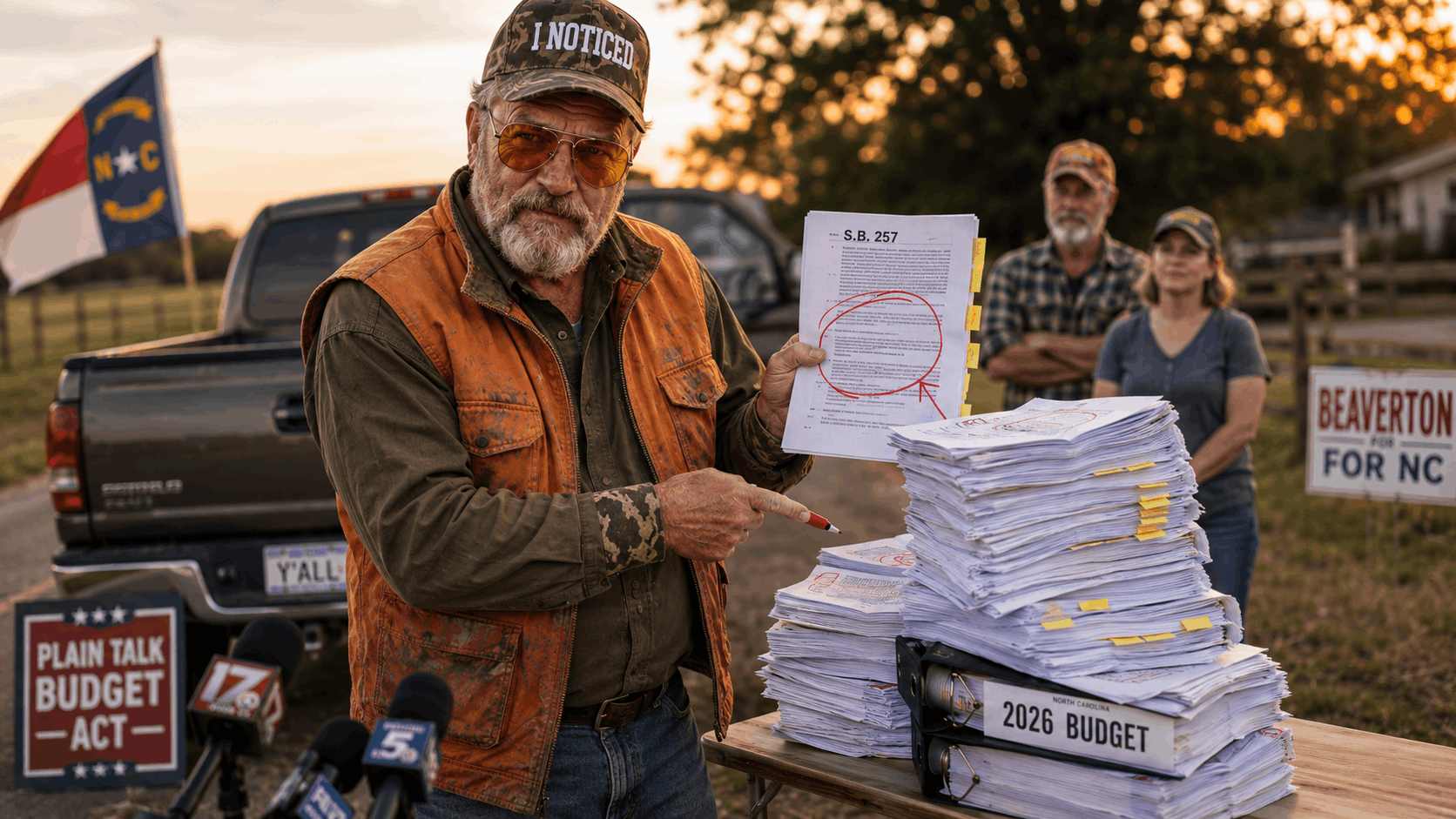
Standing beside a folding table carrying several alarming-looking stacks of paper, Lieutenant Governor candidate Cleetus Beaverton unveiled what he called the Plain Talk Budget Act. The proposal followed the release of the latest budget text, which Beaverton described as “six hundred and thirty-four pages of government explainin’ why it needs more of my money.”
“Now, I ain’t sayin’ there’s something crooked in a 634-page budget,” Beaverton said, holding up a highlighted page that appeared to concern an appropriation he had not yet identified. “I’m sayin’ if it takes 634 pages to explain where my money went, somebody done put somethin’ in there they don’t want a biscuit-eatin’ taxpayer to find.”
“A government ought to be able to explain itself before the macaroni salad gets warm.”
Cleetus Beaverton, prepared remarks, lightly edited by campaign staff
Under Beaverton’s plan, every major state spending item would arrive with what the campaign calls a Plain Talk Card: one piece of paper explaining what the money buys, who gets it, what problem it solves, and why the answer cannot simply be “administrative support.” A proposal too complicated for one card would be read aloud at a county barbecue before being allowed to move forward.
The Plain Talk Budget Act
“One piece of paper. Real words. No hiding behind a bunch of initials.” That is the campaign’s promised standard. Beaverton has also proposed that any phrase containing stakeholder engagement, capacity building, or strategic realignment trigger “a polite but firm follow-up question.”
Asked how such a system would handle genuinely complicated public programs, Beaverton said he was “not against complexity.” He was against “complexity having a government parking pass and a travel budget.”
The candidate said he had noticed “certain recurring words” in public documents, especially words that sounded “like something a man would say after he has spent too much on office chairs.” He did not name a department, a program, or a particular chair.
Beaverton further announced a volunteer Citizen Receipt Table, where North Carolinians could submit examples of government language they believe has become “needlessly sideways.” The campaign said submissions would be reviewed by volunteers “with no fewer than two highlighters and at least one person who has run a small business.”
At the close of the event, Beaverton placed a red circle around a sentence in the budget packet, then paused for reporters. “I ain’t sayin’ it proves anything,” he said. “I’m sayin’ it’s in there.”
The candidate left with the binder under one arm, a Sharpie in the other, and a new campaign promise hanging behind him: If You Can’t Explain It, You Shouldn’t Spend It.