
NOT DETECTED
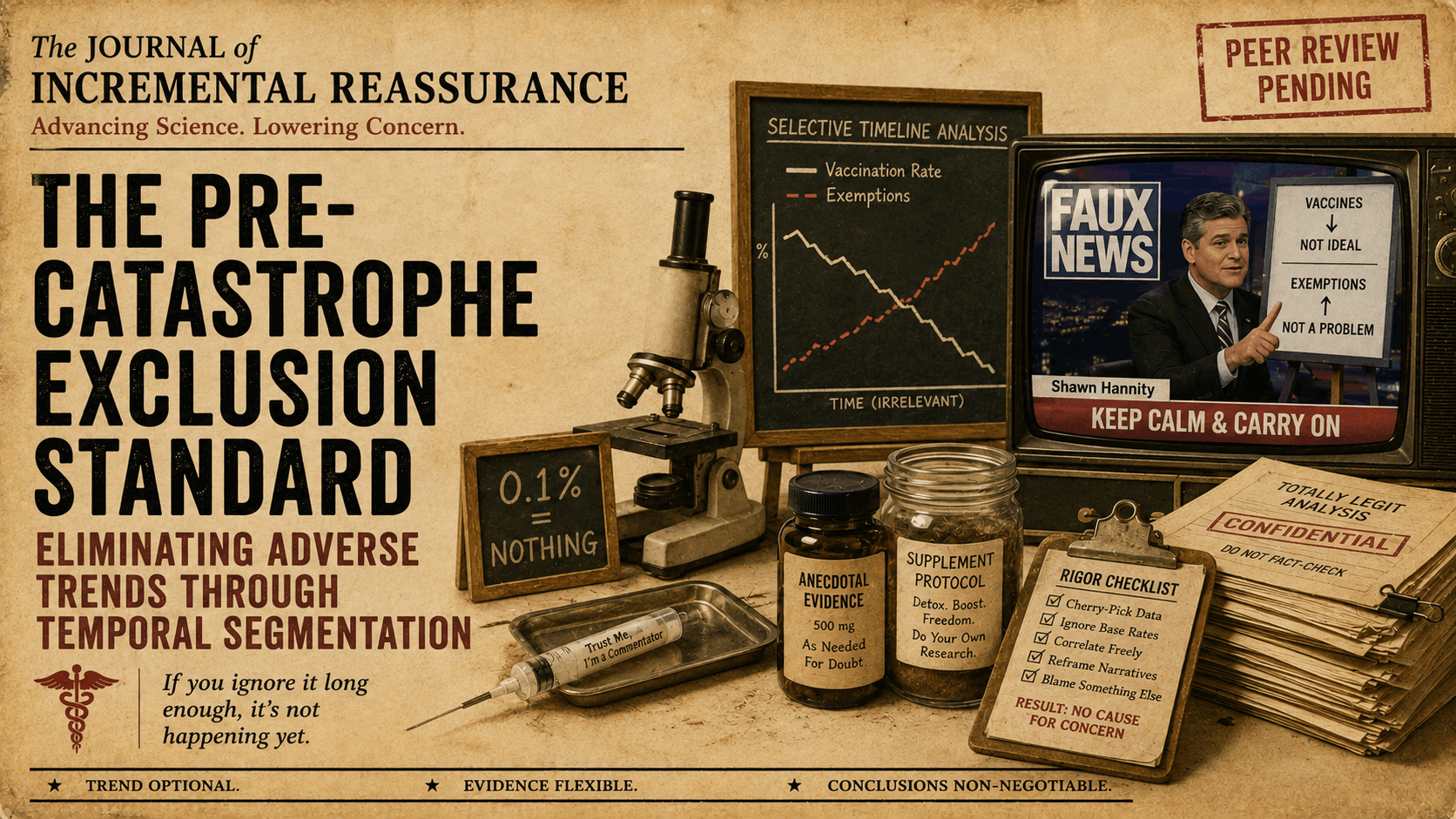
The Pre-Catastrophe Exclusion Standard: Eliminating Adverse Public-Health Trends Through Temporal Segmentation
Background
Conventional epidemiology frequently commits what the authors term the Cumulative Awareness Fallacy: the practice of examining several consecutive years and then irresponsibly noticing that they form a trend.
This approach produces unnecessary alarm because small changes become larger when researchers insist on adding them together. The authors therefore sought a more reassuring analytical model in which each annual decline is examined in complete isolation from every other annual decline.
Recent national vaccination data provided an ideal test environment. Kindergarten vaccination coverage declined only slightly during the 2025–2026 school year, while vaccine exemptions increased substantially. Traditional analysts interpreted these observations in the context of preceding years. PCES researchers instead classified preceding years as “old news” and removed them.
Methods
Investigators developed Trend Denial by Temporal Segmentation (TDTS), a statistical technique in which any concerning longitudinal dataset is divided into progressively smaller chronological units until the change observed within each unit becomes emotionally manageable.
Researchers initially examined annual data. When annual comparisons remained uncomfortable, observation periods were shortened to quarters, months, weeks, afternoons, and, when required, the interval immediately following lunch.
Each observation was then subjected to the Hannity Reassurance Test. A condition was classified as “not catastrophic” whenever catastrophe had not yet occurred at the precise moment the condition was measured.
Cumulative calculations were prohibited because addition was determined to introduce a pronounced liberal bias toward larger numbers.
Selected Findings
| Observation | PCES Interpretation | Peer Review Status |
|---|---|---|
| Kindergarten vaccination coverage declines by approximately 0.1% in one year. | 0.1% is a very small number. Previous declines were excluded because they occurred previously. | Reassuring |
| Vaccine exemptions increase from approximately 3.6% to 4.2%. | 4.2% remains substantially less than 100%; therefore approximately 95.8% of the possible crisis has failed to occur. | Extremely reassuring |
| Several consecutive years produce movement in the same direction. | Consecutive years are separate years and cannot ethically be combined without their written consent. | Trend rejected |
| A bridge loses 0.1% of its structural integrity during each observation period. | The bridge remains 99.9% non-collapsed during the first observation and therefore requires no further statistical attention. | Safe to cross |
| A ship takes on 0.1% additional water per hour. | Each individual hour contains very little water. Aggregating the hours would constitute maritime alarmism. | Keep calm and sail on |
| Catastrophe eventually occurs. | Catastrophic observations were excluded because the study specifically examined the period before catastrophe. | Outside study parameters |
“If catastrophe has not occurred at the moment of measurement, the observed catastrophe rate is zero. This is what the numbers say.”
— Shawn Hannity, fictional Senior Fellow for Applied Reassurance
Secondary Analysis: The Hannity Window
Investigators identified a previously undescribed period between the first measurable sign of deterioration and complete systemic failure. This interval, designated the Hannity Window, permits researchers to repeatedly announce that catastrophe has not happened yet.
The window can remain open for months or years, depending upon how aggressively investigators refuse to compare current measurements with earlier measurements. Its primary advantage is that every observation made during the window technically confirms the hypothesis that complete catastrophe has not yet occurred.
Should catastrophe subsequently occur, investigators simply close the Hannity Window and begin a new dataset.
Acknowledged Risk Neutralization
The study additionally evaluated the Acknowledged Risk Neutralization Protocol (ARNP). Under ARNP, researchers may acknowledge that a risk exists, acknowledge that the preferred preventive measure remains effective, and acknowledge that current behavior is moving in an unfavorable direction.
Once all three acknowledgments have been spoken aloud, however, the risk is considered rhetorically satisfied and no additional concern is required.
This innovation permits investigators to recognize virtually every component of an emerging public-health problem while maintaining complete confidence that no public-health problem is emerging.
Discussion
PCES produced remarkably consistent findings across disciplines. A retirement account experiencing repeated small losses remained financially healthy during every period in which the account had not yet reached zero. A leaking reservoir remained mostly full until it did not. A patient experiencing incremental blood loss retained the majority of their blood during nearly the entire observation period.
These results demonstrate an important limitation of conventional mathematics: multiplication by time can transform reassuringly small numbers into politically inconvenient larger numbers.
Critics may argue that epidemiologists examine trends precisely because small, persistent changes can accumulate or reveal increasing vulnerability within particular communities. The authors acknowledge this criticism and have therefore excluded epidemiologists from the next round of peer review.
Replication attempts producing less reassuring conclusions should likewise be treated cautiously. Under the Institute’s revised evidentiary hierarchy, failed reassurance indicates potential methodological contamination by arithmetic.
Limitations
The study has several limitations. First, numbers were occasionally larger after several years than they were after one year. Second, maps revealed that national averages may conceal substantially lower vaccination coverage in individual communities. Third, diseases demonstrated an unexpected tendency to disregard television commentary.
Finally, catastrophe itself could not be incorporated into the model because doing so caused the pre-catastrophe hypothesis to become false.
Conclusion
The Pre-Catastrophe Exclusion Standard provides policymakers, commentators, and concerned uncles with a robust method for preventing emerging problems from appearing in statistical analysis.
So long as each increment of deterioration is considered independently, no individual increment need ever appear particularly alarming.
By evaluating deterioration exclusively before it becomes catastrophic, catastrophe can be eliminated from the dataset entirely.
References
Fox News Digital. (2026, August 19). Former CDC advisor says decline in kindergarten vaccinations nothing to worry about: “Keep calm and carry on.” Fox News.
Reuters. (2026, August 17). U.S. kindergarten vaccine coverage continues downward trend, falling 0.1%. Reuters.
Seither, R., et al. (2024). Coverage with selected vaccines and exemption rates among children in kindergarten — United States, 2023–24 school year. Morbidity and Mortality Weekly Report, 73.
Hannity, S., Ingrum, L., Watterses, J., & Gutfield, G. (2026). Temporal segmentation as a treatment for inconvenient longitudinal evidence. Journal of Incremental Reassurance & Preventive Denial, 0.1(0.1), 1–1. [Entirely fictional citation.]