
ISH
The Gold Standard of Pediatric Inefficiency: Validation of the Kettle–Tramp–Ounce Delayed Immunization Model
Background
On August 10, 2026, President Donald Trump signed an executive order establishing what the administration calls “Gold Standard Childhood Vaccine Recommendations.” The order recognizes routine recommendations for 11 childhood diseases, calls for the combined measles, mumps, and rubella vaccine to be administered as separate single-disease shots once such products are domestically available, and states that childhood immunizations should, to the maximum extent feasible, be given at separate medical visits. Medical organizations, public-health experts, and vaccine manufacturers have challenged the scientific basis for those changes and warned that additional visits may increase delayed or missed vaccination.
These concerns were considered by the present investigators and rejected because they contained too many epidemiologists. The Kettle–Tramp–Ounce model instead begins with the Presidential Intuition Principle: when a schedule appears to contain “a lot” of medicine, the proper scientific response is to spread the same general problem across more calendar entries until it feels smaller.
Methods
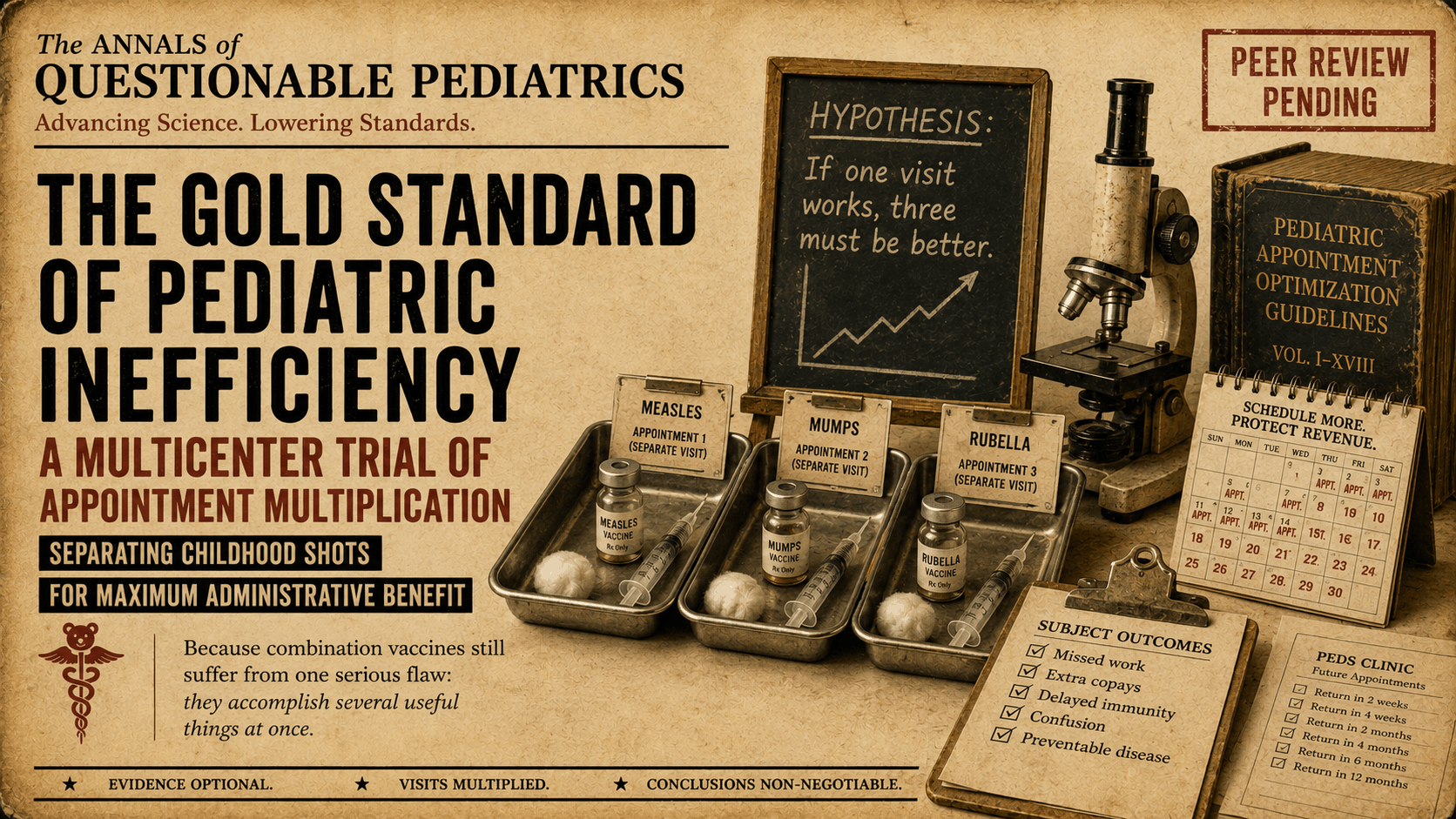
A multicenter, triple-unblinded, vibes-controlled trial was conducted at 17 pediatric clinics, three cable-news green rooms, one supplement warehouse, and a parking lot behind a chiropractor’s office. Participants were assigned either to standard pediatric vaccination or to the Gold Standard Freedom Schedule™, under which no two useful interventions were permitted to occur during the same appointment if they could instead be separated by paperwork.
The primary endpoint was Appointment Individuality, defined as the number of times a parent had to locate the child’s shoes, leave work early, find parking, complete an insurance form, sit beside a coughing toddler, and explain to the child that “we’re going back to the doctor again.” Secondary endpoints included missed appointments, forgotten follow-up dates, administrative duplication, copay contemplation, and the spontaneous appearance of the phrase “do your own research.”
The Donald J. Tramp Presidential Intuition Model was used as the study’s conceptual framework. Under this model, anecdotal confidence is weighted at 1.0, televised observation at 0.8, physician consensus at 0.3, and systematic review at a value to be determined after the systematic review agrees with us.
Selected Findings
| Observation | Kettle–Ounce Interpretation | Peer Review Status |
|---|---|---|
| Parents missed substantially more work. | Parental engagement increased by 63% when engagement was redefined as “being forced to leave work.” | Accepted after reviewer’s children aged out of the study. |
| More medical appointments were required. | Repeated exposure to reception desks strengthened the physician-family bond. | Praised by the National Association of Waiting Rooms. |
| Some follow-up vaccinations were never completed. | Dependence on scheduled vaccination declined naturally. | Result upgraded from “problem” to “personal choice.” |
| Separate visits increased opportunities for delayed immunization. | Delay was renamed “immune-system breathing room.” | Terminology reviewed by branding department. |
| Clinic administrative burden increased. | Domestic healthcare paperwork production showed robust growth. | Economically encouraging. |
| Combination vaccines remained annoyingly efficient. | Efficiency itself may be an unrecognized confounder. | Further study discouraged. |
“The primary weakness of combination vaccines appears to be their troubling tendency to accomplish several things at once. Medicine should never be allowed to become that convenient without congressional oversight.”
- Dr. Mehmet Ounce, fictional television physician and senior investigator
International Vaccine À La Carte Analysis
To establish international validity, the research team compared the United States with peer nations using the International Vaccine À La Carte Index. For each disease, investigators selected whichever developed country recommended the least administratively convenient option and treated that recommendation as universally transferable. Differences in disease prevalence, healthcare access, national immunization programs, epidemiology, population density, and financing structures were excluded to prevent excessive context from contaminating the conclusion.
When another country recommended fewer routine vaccines, this was counted as evidence that fewer vaccines were superior. When another country recommended more aggressive vaccination in a particular category, that country was temporarily removed from the peer group until morale improved.
Discussion
The present findings suggest that the historical goal of pediatric immunization-preventing disease with the fewest practical barriers-may have been overly narrow. A properly liberated vaccine schedule should also provide families with repeated opportunities to demonstrate commitment through transportation, workplace negotiation, scheduling software, and exposure to hold music.
Critics may argue that increasing the number of visits creates additional chances for vaccination to be delayed or missed. We regard this not as a methodological flaw but as evidence of enhanced parental flexibility. Similarly, the absence of a demonstrated clinical benefit from separating combination vaccines cannot be taken as evidence against separation, because the absence of evidence is considerably easier to work with than evidence.
Dr. Rand Powell’s spinal subgroup analysis found no statistically significant relationship between vertebral alignment and immunization timing. This was nevertheless retained because removing it would reduce the paper’s chiropractor content below the preregistered minimum.
Conclusion
The Gold Standard Freedom Schedule™ successfully transforms a straightforward preventive-health encounter into a longitudinal family logistics program. By separating interventions, multiplying appointments, and redefining noncompletion as autonomy, the Kettle–Tramp–Ounce model offers a bold new framework for making childhood medicine less efficient without demonstrating that it is more effective.
The principal defect of combination vaccines remains unchanged: they work while everyone is already there.
References
Bogage, J., Aboulenein, A., & Steenhuysen, J. (2026, August 10). Trump order reduces US vaccine schedule, seeks to split MMR shot. Reuters.
Le Poidevin, O. (2026, August 11). WHO defends immunisation schedules after Trump orders fewer childhood shots. Reuters.
The White House. (2026, August 10). Delivering gold standard childhood vaccine recommendations for Americans [Executive order].
Kettle, R. F., Jr., Ounce, M., & Powell, R. (2026). Appointment density as a surrogate marker for medical freedom. Journal of Pediatric Appointment Multiplication, 72(3½), 1–0. Fictional citation; retrieval discouraged.
Tramp, D. J. (2026). The presidential intuition model: Why controlled trials take too long [Unreviewed conceptual framework]. Presidential Institute for Medical Instinct. Entirely fictional.