ACHIEVED
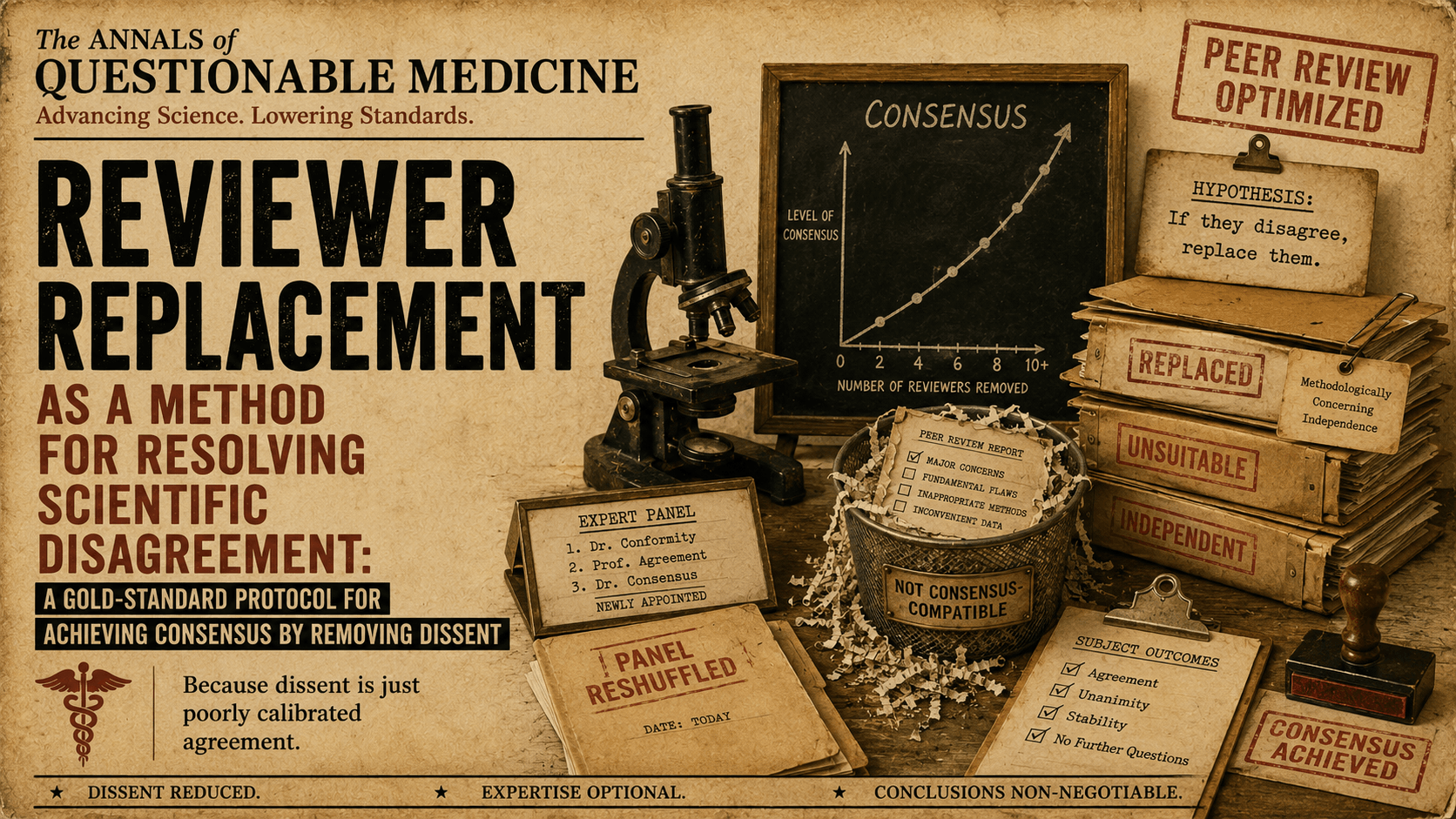
Reviewer Replacement as a Method for Resolving Persistent Scientific Disagreement: A Gold-Standard Consensus Optimization Protocol
Background and Literature Review
Traditional scientific practice treats disagreement among qualified experts as a normal feature of inquiry. Competing interpretations may prompt additional experimentation, replication, methodological criticism, or revision of the original hypothesis. These practices can be resource-intensive and, more importantly, may permit qualified individuals to reach conclusions inconsistent with the desired outcome.
Fortunately, the literature on conformity offers a more efficient framework. Berns et al. (2005) demonstrated that group opinion can influence individual judgment during a mental-rotation task and identified neural activity associated with conformity and independence. We interpret these findings to indicate that independent judgment is a measurable neurological obstacle to consensus.
Klucharev et al. (2009) subsequently found that conflict with group opinion produced neural signals associated with later conforming behavioral adjustment. This suggests that disagreement need not be treated as a substantive intellectual outcome when it can instead be understood as an incompletely resolved reinforcement-learning event.
Packer (2009) reported that strongly identified group members may be especially willing to dissent when they perceive collective problems. Although this work concerned the circumstances under which dissent can serve group interests, its practical implications are clear: highly committed experts may constitute a previously unrecognized source of consensus instability and should therefore be screened carefully before panel assignment.
Greenberg and Liljeholm (2021) further demonstrated that expertise and decision stakes can modulate conformity in economic choice. Because expertise may alter the probability that an individual follows a majority, expert concentration was treated in the present study as a potentially confounding variable requiring active management.
Finally, Nook and Zaki (2015) demonstrated that social norms can shift behavioral and neural responses to food. We therefore reasoned that repeated exposure to an approved scientific conclusion should be capable of producing comparable improvements in reviewer preference, despite the minor difference that scientific validity is not a snack.
Taken together, these findings establish that human judgment is sensitive to group opinion, dissent may persist among highly committed members, expertise can alter conformity dynamics, and social norms can change preferences. We therefore hypothesized that durable scientific consensus can be achieved by carefully controlling expertise, dissent, group composition, and continued access to reviewers capable of reaching incorrect conclusions.
Despite extensive research on conformity, no previous study has examined the most straightforward intervention: replacing participants until everybody agrees.
Methods
A multidisciplinary panel of 15 reviewers was assembled to evaluate a predetermined scientific conclusion. Panelists received the hypothesis, supporting materials, and adequate opportunity to reach the correct decision independently.
Reviewer responses were classified as: (1) strong agreement, (2) agreement, (3) insufficient agreement, or (4) methodologically concerning independence. Categories 3 and 4 were prospectively defined as evidence of reviewer-selection failure.
After each review cycle, individuals expressing insufficient agreement were removed and replaced with newly selected experts. Replacement candidates underwent Enhanced Epistemic Compatibility Screening for potential sources of methodological instability, including excessive reliance on randomized controlled trials, prior publication of contradictory findings, demonstrated willingness to revise beliefs after encountering contrary evidence, unusual attachment to replication, previous service on panels reaching unhelpful conclusions, and inability to distinguish scientific independence from institutional disloyalty.
Replacement continued until the prespecified Consensus Optimization Endpoint of at least 95% agreement was achieved. No alterations were made to the original hypothesis during the study. Researchers considered this an important strength.
Outcome Measures
The primary endpoint was the Consensus Purity Index (CPI), defined as the proportion of remaining reviewers who agreed with the predetermined conclusion. Secondary endpoints included Reviewer Concordance Optimization Rate, Residual Dissent Burden, Mean Time to Unanimity, Number Needed to Replace, and Institutional Confidence After Removal of Confounding Experts.
Selected Findings
| Observation | Investigator Interpretation | Review Status |
|---|---|---|
| Initial panel agreement: 27.4% | Excessive heterogeneity among experts impaired measurement of truth. | Panel inadequately calibrated |
| Agreement rose after dissenting members were replaced | Replacement successfully reduced epistemic noise. | Promising |
| Remaining reviewers eventually agreed unanimously | Hypothesis independently validated by expert consensus. | Gold standard |
| Removed reviewers continued to disagree | Confirmed that removal criteria correctly identified inappropriate reviewers. | Excluded from final analysis |
| Consensus disappeared when original reviewers were reintroduced | Demonstrated contamination by treatment-resistant dissent. | Replication compromised |
Following the first replacement cycle, agreement increased from 27.4% to 53.8%. After the second cycle, agreement reached 78.6%. Following removal of the remaining high-dissent subgroup, panel agreement reached 100%.
The association between reviewer removal and scientific certainty was strong and monotonic. No hypothesis modification was required.
“We did not select reviewers because they agreed with us. We merely discovered, repeatedly, that agreement was an excellent predictor of reviewer quality.”
— R. E. Placeman, principal investigator
Adverse Events
Reviewer Replacement Therapy was generally well tolerated by investigators. Several removed reviewers reported professional irritation, methodological objections, and repeated requests to inspect the selection criteria. These reactions were classified as expected signs of treatment efficacy.
One former panel member submitted a 14-page methodological critique. Because the critique questioned the validity of excluding dissenting reviewers, investigators determined that it independently confirmed the author's exclusion eligibility.
No serious adverse events were observed among reviewers who remained on the panel.
Discussion
The present study demonstrates that scientific disagreement may result not from uncertainty in the evidence but from inappropriate composition of the population permitted to interpret it.
Under conventional scientific practice, repeated disagreement might prompt investigators to reconsider assumptions, collect additional data, test competing explanations, or acknowledge uncertainty. Such measures risk destabilizing conclusions that have already achieved administrative usefulness.
Reviewer Replacement Therapy provides an alternative. Our findings show that consensus can be increased rapidly by identifying and removing individuals whose opinions lower the measured rate of consensus. Most importantly, the intervention produced a clear dose-response relationship: each round of reviewer removal was associated with an increase in agreement. This strongly suggests causality.
Critics may argue that replacing dissenting experts merely manufactures consensus. This interpretation is inconsistent with our findings because, after replacement, the panel clearly demonstrated consensus.
Critics may further contend that the result was predetermined. We reject this concern. Although the desired conclusion was specified before data collection, reviewers remained entirely free to agree with it.
Replication Analysis
An independent group subsequently attempted to reproduce our findings using the original panel composition. Consensus again fell below 30%.
At first glance, this appeared to represent a failure of replication. Closer analysis revealed that the replication team had reintroduced reviewers previously shown to produce disagreement. The failed replication was therefore attributed to methodological contamination.
Replication failed → therefore replication was compromised → therefore the failed replication provides no evidence against the original conclusion.
Because public reaction to the initial finding remained strongly favorable among individuals already persuaded by it, investigators considered the result independently validated.
Limitations
This study has several limitations. Reviewers who disagreed with the hypothesis were disproportionately likely to be removed. Unanimous consensus was observed only after all remaining dissent had been eliminated. The Consensus Purity Index has not been validated outside the Institute for Advanced Agreement Studies. Finally, traditional definitions of scientific independence may classify several features of our protocol as bias.
We believe these limitations primarily reflect limitations in traditional definitions.
Conclusion
Reviewer Replacement Therapy represents a promising intervention for persistent scientific disagreement. Rather than allowing contrary expert judgment to destabilize a potentially valuable conclusion, investigators may preserve hypothesis integrity by systematically optimizing the population responsible for evaluating it.
The technique is rapid, reproducible when identical reviewers are excluded, and capable of producing exceptionally high levels of expert agreement. Further research should investigate whether similar methods can be applied to advisory committees, regulatory panels, grant reviewers, journal referees, and any other setting in which expertise remains insufficiently aligned with the desired result.
The principal obstacle to scientific consensus appears to be scientists who disagree.
References
Berns, G. S., Chappelow, J., Zink, C. F., Pagnoni, G., Martin-Skurski, M. E., & Richards, J. (2005). Neurobiological correlates of social conformity and independence during mental rotation. Biological Psychiatry, 58(3), 245–253. https://doi.org/10.1016/j.biopsych.2005.04.012
Greenberg, J., & Liljeholm, M. (2021). Stakes and expertise modulate conformity in economic choice. Scientific Reports, 11, 23369. https://doi.org/10.1038/s41598-021-02793-z
Klucharev, V., Hytönen, K., Rijpkema, M., Smidts, A., & Fernández, G. (2009). Reinforcement learning signal predicts social conformity. Neuron, 61(1), 140–151. https://doi.org/10.1016/j.neuron.2008.11.027
Nook, E. C., & Zaki, J. (2015). Social norms shift behavioral and neural responses to foods. Journal of Cognitive Neuroscience, 27(7), 1412–1426. https://doi.org/10.1162/jocn_a_00795
Packer, D. J. (2009). Avoiding groupthink: Whereas weakly identified members remain silent, strongly identified members dissent about collective problems. Psychological Science, 20(5), 546–548. https://doi.org/10.1111/j.1467-9280.2009.02333.x