
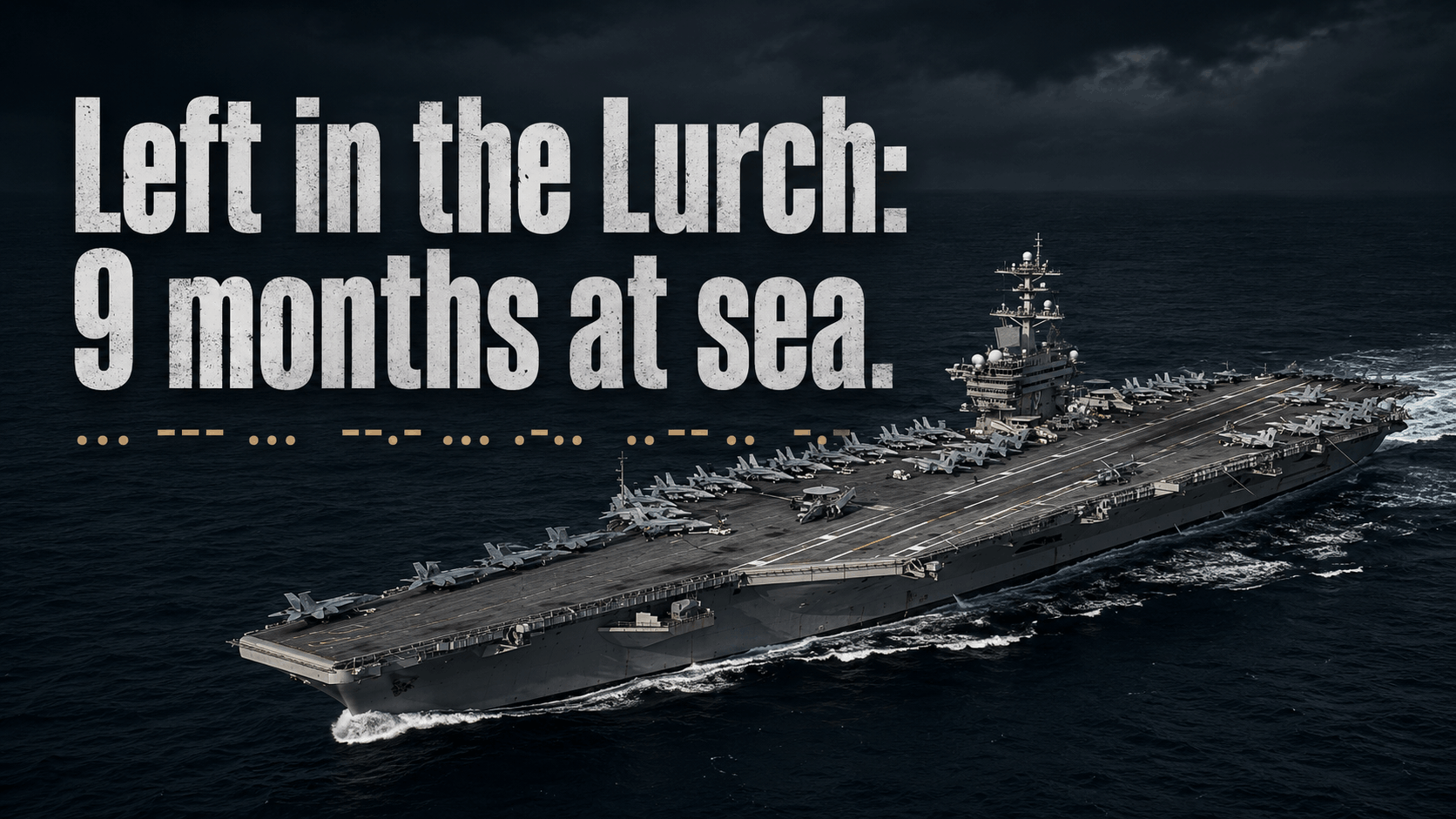
Left in the Lurch:
9 Months at Sea
The USS Abraham Lincoln is not just a story about an exhausted crew. It is a test of whether the Pentagon knows how to sustain the missions it orders.
I don't particularly care which political team gets blamed for this one.
Seriously.
Set the politics aside for a minute.
I want to know how the United States Navy gets an aircraft carrier and roughly 5,000 sailors and Marines into a situation where an already-long deployment keeps getting extended, the crew goes months without a normal port call, families start publicly describing deteriorating living conditions and severe strain, and somehow we're supposed to regard all of that as simply the price of doing business.
Because that's not toughness.
That's a planning problem.
“Amateurs talk tactics. Professionals talk logistics.”Old military adage, in one of its many forms
The USS Abraham Lincoln left San Diego on November 21, 2025. The deployment was expected to last about seven months. Instead, by August it was pushing into a ninth month, with more than 200 days reportedly passing without a port call.
Families have publicly raised concerns about food, toiletries, mail, laundry, plumbing, hot water, mold and mental strain aboard the ship. The Navy has disputed some of the more alarming descriptions, particularly claims involving suicidal behavior, while acknowledging the strain that an extended deployment places on sailors and families.
Fine. We should be precise about that distinction.
But suppose only half of the worst reports are accurate.
That's still bad.
We're not talking about some exotic weapons system nobody could reasonably anticipate.
We're talking about feeding people. Washing clothes. Keeping toilets working. Moving mail. Supplying hygiene products. Giving exhausted human beings some reasonable idea of when somebody else is going to relieve them.
Those are not luxuries.
They are sustainment.
Everybody loves the exciting part.
Aircraft launching. Missiles firing. Carrier strike groups moving across maps. Briefing slides full of arrows.
Nobody makes recruiting commercials about spare parts, preventive maintenance, replenishment schedules, potable water, food inventories or sewage systems.
Too bad.
That is what keeps a military functioning.
You can have the finest aircraft in the world sitting on the finest carrier ever built, but somewhere underneath all that technology is a 22-year-old sailor who needs sleep, food, a shower and a functioning toilet.
Eventually that sailor needs to go home.
That's logistics too.
Combat power is not merely whether you can hit a target tonight. It is whether you can keep generating credible combat power tomorrow, next month and six months from now.
Plans change. Of course they do.
Enemies get a vote. Intelligence changes. Missions expand. Supply routes become dangerous. Ships get diverted. Operations last longer than somebody predicted.
Nobody serious expects the original plan to survive reality untouched.
What I expect is another plan.
And another one after that.
If the deployment goes thirty days longer than expected, what happens?
Sixty?
Ninety?
If a normal logistics hub becomes unavailable or dangerous, where is Plan B?
If Plan B becomes unreliable, where is Plan C?
What happens to food, maintenance, medical support, personnel readiness, mail, spare parts and crew rotation?
Those are not questions you start asking after people are already exhausted.
They're supposed to be part of the planning process.
There is a major difference between hardship imposed by the enemy and hardship imposed by our own failure to adjust a plan.
This isn't an argument that Pete Hegseth never served.
He did.
He was an Army National Guard infantry officer. He deployed to Guantanamo Bay, Iraq and Afghanistan. His official biography lists two Bronze Stars and the Combat Infantryman Badge.
Give him every bit of credit he earned.
But let's not confuse two completely different things.
Serving as an infantry officer and running the Pentagon are not remotely the same job.
The civilian leader of the department sits above an enormous institution involving millions of service members and civilians, combatant commands, global logistics, transportation, maintenance, acquisition, medical systems, munitions production, intelligence, nuclear forces and a budget measured in hundreds of billions of dollars.
Hegseth did not arrive with senior joint-command experience or a record of managing an institution remotely comparable in size and complexity.
That matters now.
Not because a general should automatically run the Pentagon. The military answers to civilian authority, and it should.
Civilian control does not require amateur leadership.
The Pentagon chief does not need to know how to repair a carrier's plumbing himself. He does need to know enough about the institution to ask whether the logistics architecture can support the operational plan, whether personnel are being consumed faster than readiness can be regenerated, and what the branch plan is when the original assumptions fail.
If he doesn't know the answer, he needs people around him who do.
Then he needs to listen to them.
And when reality says the plan is failing, he needs to change course.
One of the worst habits any large organization can develop is treating a change in direction as an admission of weakness.
Sometimes continuing exactly as planned is the failure.
If the personnel assumptions were wrong, change them.
If the logistics assumptions were wrong, change them.
If the expected duration was wrong, change the rotation.
If the supply network cannot support the operational tempo, strengthen the network, add capability or change the tempo.
You do not get extra points for discovering how much misery human beings can tolerate.
Of course sailors can endure terrible conditions.
That's almost beside the point.
The question is whether they needed to.
Hegseth doesn't get to own the aircraft launches and hand the broken toilets to somebody farther down the chain. Authority travels downward. Responsibility travels upward.
A sailor reaching exhaustion isn't a character flaw.
A broken washing machine isn't a character test.
A malfunctioning toilet isn't warrior ethos.
Running people into the ground doesn't prove how formidable your military is.
It can prove exactly the opposite.
Readiness isn't merely how many aircraft can launch tonight.
It's whether you can launch them tomorrow.
And next week.
And three months from now.
It is whether the ship remains maintained, whether the crew remains effective, whether replacement forces are available and whether the institution can absorb another crisis somewhere else without discovering that every supposedly temporary measure has quietly become permanent.
Anybody can sprint.
Wars have an irritating habit of becoming marathons.
Maybe there were perfectly reasonable plans for all of this.
Maybe circumstances overwhelmed them.
Maybe the threat environment made ordinary replenishment much harder.
Maybe relief forces simply were not available quickly enough.
Those are plausible explanations.
But explanations are not solutions.
After this many months, “the situation changed” isn't enough anymore.
Of course it changed.
That's what situations do.
Planning exists because situations change.
So I don't need another partisan argument.
I don't particularly care who gets the cleverest sound bite.
I want the boring questions answered:
- What was the expected duration?
- What were the sustainment assumptions?
- What warning indicators were established?
- What was the relief plan?
- Who approved each extension?
- What changed when the original assumptions failed?
- And if nothing changed quickly enough, why not?
Because sailors don't eat mission statements.
They don't shower in PowerPoint slides.
And you cannot indefinitely substitute endurance for planning.
The Bottom Line
I don't need Pete Hegseth to be a four-star general.
I need the civilian sitting at the top to understand the institution well enough to know which questions to ask, and to recognize a bad answer when he hears one.
The Lincoln should force those questions.
The food matters.
The plumbing matters.
The mail matters.
The deployment length matters.
The exhaustion matters.
But taken together, they start pointing upstream.
Planning.
Logistics.
Leadership.
The amateurs can keep talking about targets. The professionals need to start asking how long we can actually keep doing this.
Sources & Further Reading
- Raw Story, reporting on the USS Abraham Lincoln deployment and crew conditions.
- Office of Sen. Richard Blumenthal, Aug. 12, 2026, letter seeking answers on deployment extensions, health, safety and support.
- The Guardian, Aug. 12, 2026, reporting on the extended deployment, family concerns and the Navy's response.
- U.S. Department of War, official Pete Hegseth biography and military background.