DETAILS OPTIONAL
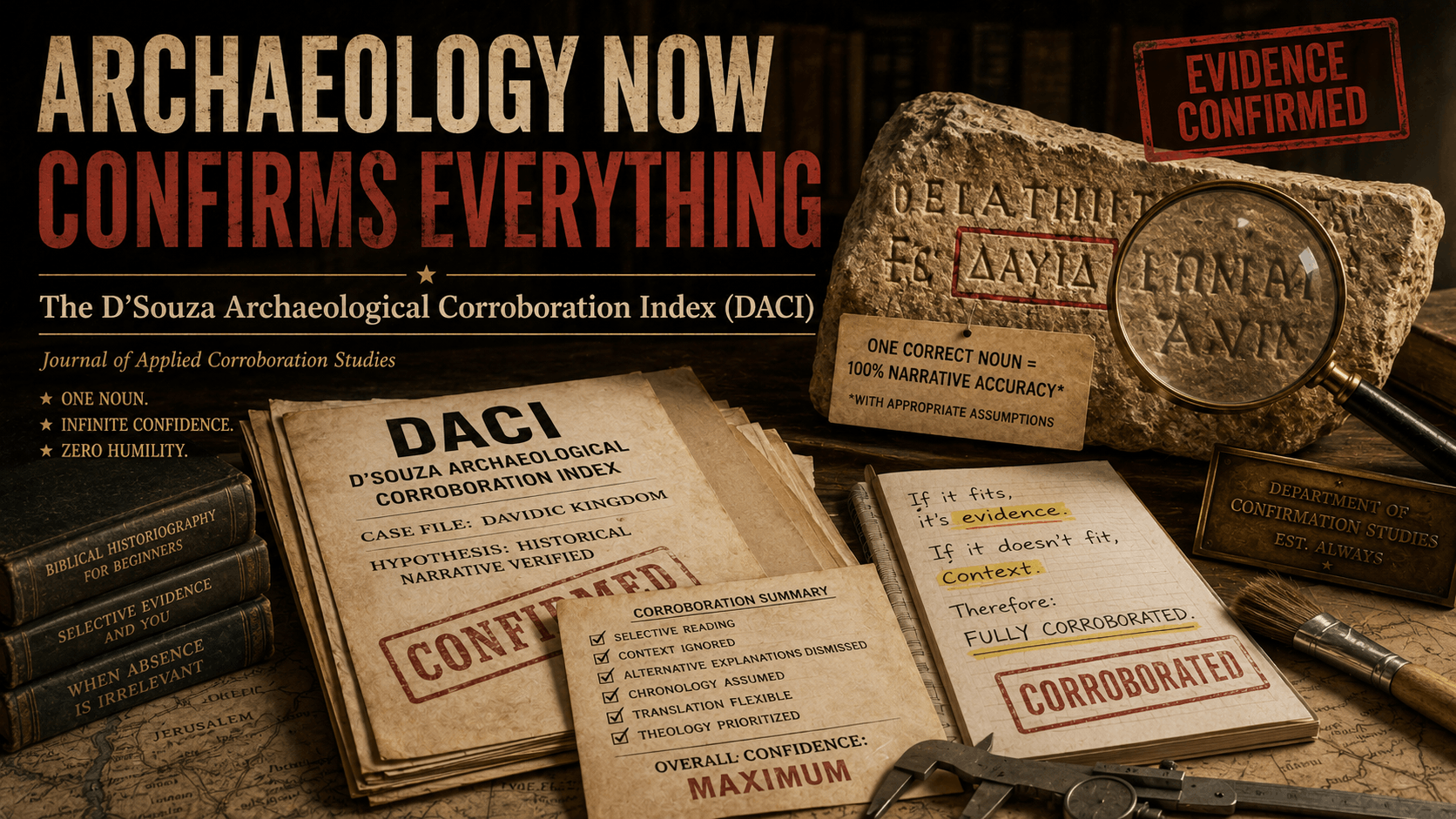
The D’Souza Archaeological Corroboration Index (DACI): A Bayesian-Free Method for Establishing Total Narrative Accuracy from the Discovery of One Correct Noun
Background
Public discussions of biblical archaeology sometimes slide from a modest claim — that an inscription or artifact supports the historical existence of a named person, title, or location — to a much larger claim that archaeology therefore corroborates the wider narrative in which that detail appears. A Fox News interview published August 9, 2026, highlighted Dinesh D’Souza’s forthcoming book The Stones Cry Out and cited examples including the Pilate Stone, the Deir ‘Alla inscription referring to Balaam son of Beor, and an ossuary associated with the name Caiaphas. The present study does not evaluate religious belief, theology, or the historical value of those artifacts. Instead, it examines the exhilarating methodological possibilities created when corroboration of a noun is permitted to spread freely through the surrounding prose.
Methods
We developed DACI after determining that conventional standards of historical inference were suppressing potentially publishable certainty. Each source text was scanned until investigators identified at least one independently attested person, place, object, title, profession, food item, geological formation, or preposition. That item was assigned an Initial Corroboration Value (ICV) of 1.0. Through Narrative Spillover, the ICV was then propagated in both directions until reaching the beginning and end of the document. No Bayesian priors, alternative explanations, genre distinctions, textual criticism, or contrary evidence were permitted to reduce the score, as all were judged likely to interfere with the outcome.
Selected Findings
| Observation | [RESEARCHER]'s Explanation | Peer Review Status |
|---|---|---|
| Baker Street exists in London. | Sherlock Holmes therefore achieves 97.3% historical confidence; residual uncertainty concerns only Dr. Watson’s handwriting. | Accepted after locating London. |
| Archaeology confirms the ancient city of Troy. | Achilles is upgraded from literary figure to conditionally invulnerable combatant, pending excavation of the relevant heel. | Statistically heroic. |
| Trump Tower exists in New York City. | Home Alone 2 is reclassified as a primary-source chronicle of the Late American Period. | Peer reviewed by concierge. |
“We used to waste enormous amounts of time asking whether an artifact supported the specific proposition under discussion. DACI frees archaeology from that bottleneck by allowing one verified noun to carry the entire paragraph.”
— Dr. Digby Trowell, principal investigator and owner of three progressively larger brushes
Discussion
Critics may object that demonstrating the existence of Pontius Pilate does not, by itself, establish every event described in every text that mentions him. DACI regards this objection as a category error arising from continued attachment to conventional evidentiary standards. Under Rule 4.2, Narrative Spillover, corroboration of a proper noun automatically increases the confidence assigned to neighboring claims. If contradictory evidence appears, the contradiction itself confirms that the subject has generated enough scholarly interest to be controversial, producing a Secondary Controversy Bonus of +0.14. A complete absence of evidence is classified as Excavation Pending and therefore carries no penalty.
Conclusion
DACI demonstrates that the chief obstacle to decisive archaeological confirmation is not a shortage of artifacts, but the traditional insistence that evidence support the particular claim being made. Once that restriction is removed, history becomes considerably easier to verify. The absence of evidence should never be confused with evidence of absence, particularly when the book is already available for preorder.
References
Margolis, A. (2026, August 9). Author Dinesh D’Souza challenges Bible skeptics with ‘startling’ archaeological discoveries. Fox News. https://www.foxnews.com/travel/dinesh-dsouza-challenges-bible-skeptics-startling-archaeological-discoveries
Trowell, D., & Ate, C. D. (2026). Narrative spillover and the evidentiary multiplication of nouns. Journal of Applied Corroboration Studies, 19(4), 1–19. Fictional article; DOI withheld pending discovery.