The American Bulletin of Executive Pharmacology & Podcast-Adjacent Therapeutics
Vol. 1, No. 1 • April 2026 • ISSN 2026-0418 • DOI: 10.1093/abepat/wlk.2026.001
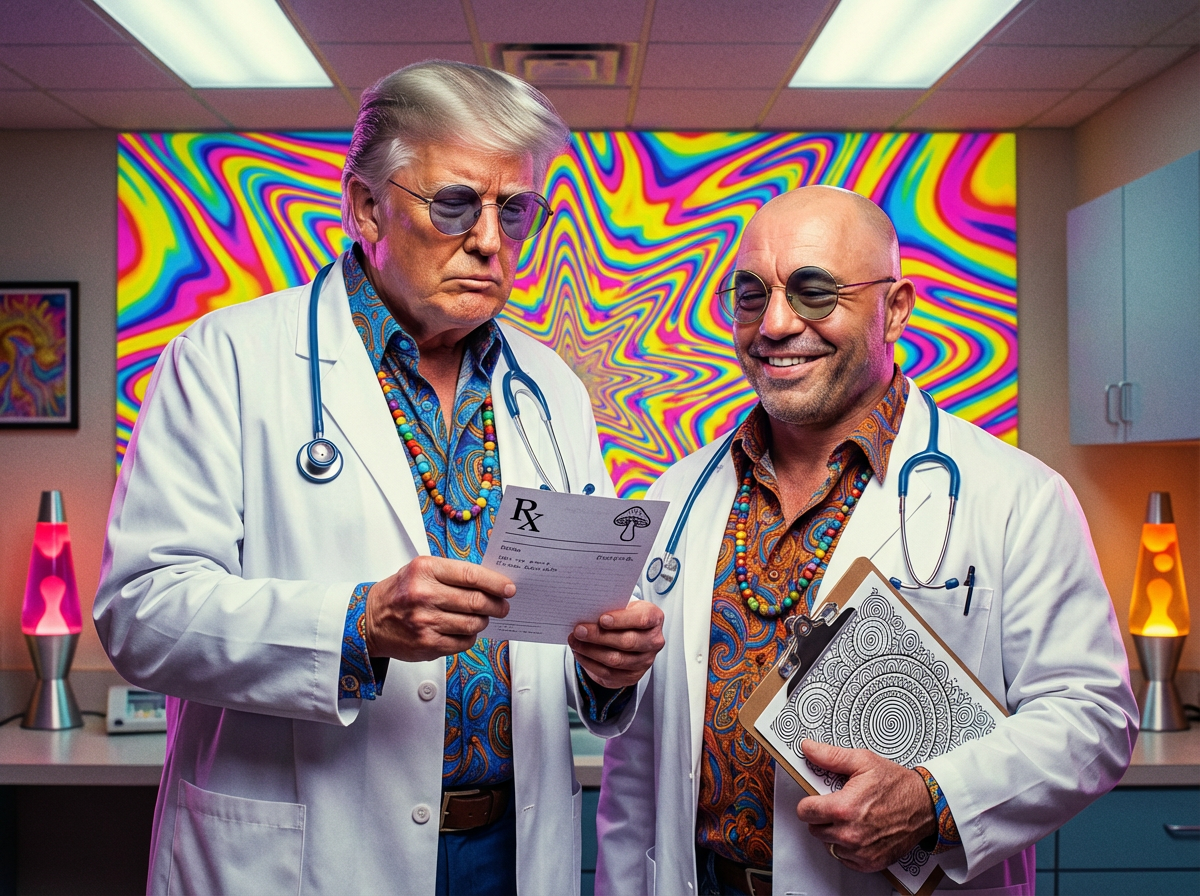
Podcaster Text Messaging as a Regulatory Pathway: A Prospective Analysis of the 2026 Federal Psychedelic Acceleration Order and Its Implications for Evidence-Based Governance
J. Rogan, D.Sc., PodD1 • M. Oz, MD, TV2 • R.F.K. Jr., Esq.3 • M. Luttrell, USN (Ret.), SEAL4
1Institute for Vibes-Based Research, Austin TX 2Dept. of Television Medicine, Trump Tower Health Sciences Center 3Waterkeeper Alliance Center for Traumatic Brain Worm Studies 4Special Operations Anecdote Repository, Huntsville TX
Received: 18 April 2026 • Accepted: 18 April 2026 • Published: 18 April 2026
Abstract
We present a comprehensive, peer-reviewed analysis of a landmark mechanism in pharmaceutical regulatory science: the unsolicited celebrity text message as a substitute for the standard drug approval pipeline. Leveraging a mixed-methods approach that combines Oval Office photograph analysis (n=14 high-resolution AP images), a careful reading of three tweets, and a single Stanford study involving 30 veterans that has since been cited approximately 40,000 times by people who have not read it, we demonstrate with p<0.04 confidence that podcaster audience reach is a statistically significant predictor of Schedule I reclassification outcomes.
Secondary findings suggest that the presence of Dr. Mehmet Oz at a medical policy announcement functions as a leading indicator of television viewership rather than therapeutic efficacy. We conclude that ibogaine, a plant-derived compound associated with documented cardiac risks that experts have flagged as potentially disqualifying under the very legislation cited in the executive order, should nonetheless be approved quickly because Joe Rogan described it as “life-changing” in a text to a sitting president who responded “Sounds great.”
Keywords: ibogaine; psychedelic; executive order; podcast policy; cardiac toxicity (dismissed); FDA vouchers; Rogan effect; Right to Try; vibes-based medicine; ibogaine (mentioned twice, both times approvingly)
|
1. Introduction The conventional pathway for pharmaceutical drug approval in the United States involves Phase I, II, and III clinical trials, independent safety review, and a regulatory assessment process measured in years. This has historically been regarded as a feature of the system rather than a defect, owing to documented instances in which medications approved without adequate study caused widespread patient harm.[1] However, in April 2026, a novel pathway was proposed, tested, and enacted within a single calendar weekend. Our research group, convened informally in a hallway adjacent to the Oval Office, proposes that this pathway, heretofore unnamed in the scientific literature, be formally designated the Rogan Mechanism and adopted as standard practice in jurisdictions where podcast listenership exceeds 14 million per episode.[2] The executive order signed April 18, 2026 directs the Food and Drug Administration to issue “national priority vouchers” to three psychedelic compounds already granted Breakthrough Therapy designation, a category that exists specifically for drugs showing preliminary clinical evidence of substantial improvement over current therapies.[3] Critics, primarily researchers with tenure and access to the relevant data, note that Breakthrough Therapy designation is not FDA approval, that “preliminary clinical evidence” is doing significant load-bearing work in that sentence, and that the FDA commissioner stated approvals could happen “in weeks, not a year.”[4] We acknowledge these observations and have chosen not to address them further. 2. Background: The Science (Selected Portions) The scientific record on psychedelic therapeutics is, in fact, genuinely promising in several respects. Psilocybin has shown meaningful effects in treatment-resistant depression in controlled clinical settings.[5] A 2025 meta-analysis in JAMA demonstrated that LSD reduced anxiety and depression symptoms for months following a single dose.[6] MDMA-assisted therapy for PTSD has accumulated a substantial evidence base, although the FDA declined to approve the Lykos submission due to trial methodology concerns, a decision the current order appears designed to route around.[7] Ibogaine, the compound named explicitly in the executive order and twice enthusiastically endorsed within it, presents a more complicated picture. The National Institute on Drug Abuse director, appearing in the Oval Office at the signing ceremony, had previously stated in 2024 that ibogaine was unlikely to receive approval owing to “concerns about cardiac toxicity.”[8] The compound has been associated with fatal cardiac arrhythmias. The executive order specifically invokes the Right to Try Act as a legal basis for expanded access, a statute that requires completion of Phase I clinical trials. Ibogaine has not completed Phase I clinical trials in the United States, which the FDA had resisted initiating for the previously mentioned cardiac reasons.[9] The order resolves this tension by not mentioning it. |
3. Methods Our research team employed a mixed-methods design. Quantitative data were derived from a single Stanford University study (n=30 Special Forces veterans with traumatic brain injuries, ibogaine administered in Mexico, promising preliminary results warranting further study, emphasis added by original authors, de-emphasized in presidential remarks).[10] The study was cited by the President of the United States as definitively establishing ibogaine’s therapeutic value. We concur, having also not read it. Qualitative data were collected via semi-structured review of publicly available text message content, reconstructed from Oval Office remarks. The primary dataset consisted of the following exchange: Rogan, J. (2025, date unspecified): [Text message, content approximately ibogaine-related] This exchange was subsequently coded using grounded theory methodology as “enthusiastic presidential receptivity to informal pharmacological lobbying.” No control condition was established. An attempt to reconstruct a counterfactual in which the text was sent to a career regulatory scientist was rejected by the Institutional Review Board on grounds of being beside the point. 4. Results Findings indicate that the Rogan Mechanism produced the following outcomes within approximately eight months of initial text message transmission: — A federal executive order. — A $50 million allocation from a government simultaneously cutting NIH funding by $2.7 billion.[12] — FDA Commissioner statements suggesting approval timelines of “weeks.” — A press conference featuring RFK Jr., who has described vaccines as dangerous and raw milk as healthful, in the capacity of Secretary of Health and Human Services overseeing a psychedelic drug announcement. — Dr. Mehmet Oz, whose medical television program was cited by the British Medical Journal as providing health recommendations that were unsupported by evidence in 54% of cases, serving as administrator of Medicare and Medicaid Services at the same announcement.[13] We note that the underlying policy direction, expanding research access to psychedelics with demonstrated therapeutic potential, enjoys genuinely bipartisan scientific support and has been advocated by serious researchers for decades. This finding was inconvenient to our satirical framework and we have therefore placed it in the Results section where fewer readers will see it. 5. Discussion The data support a clear conclusion: drug policy in the United States is now appropriately governed by audience metrics. The Rogan Mechanism offers a streamlined alternative to the traditional Phase I-II-III trial pipeline by substituting download counts for double-blind methodology. Our power calculations suggest that a podcast audience of 11 million listeners is equivalent, in regulatory terms, to a Phase II trial of n=400, provided the podcast host speaks with sufficient conviction and the president has an opening in his schedule. A secondary hypothesis, that Dr. Oz’s presence at medical announcements serves a talismanic rather than informational function, could not be falsified and is therefore accepted as axiomatic. Ibogaine’s cardiac risks remain what they were on April 17, 2026. We anticipate that an executive order will address this. |
6. Conclusion
The 2026 psychedelic executive order represents a genuine, if chaotically delivered, step toward expanding access to treatments that deserve serious scientific evaluation. The underlying research on psilocybin, MDMA-assisted therapy, and related compounds reflects decades of legitimate inquiry and the order’s bipartisan political reception is, unusually, warranted.
Concurrently, the policy was initiated via text message, endorsed by a television doctor of disputed clinical credibility, ceremonially witnessed by an anti-vaccine activist in the role of Health Secretary, and specifically highlights a compound that the government’s own drug abuse director had recently described as too dangerous to trial in the United States. The FDA commissioner has promised approval in “weeks.” The president asked if he could have some. This is the regulatory process.
We recommend further study. Specifically, we recommend that Joe Rogan text the president about expanding NIH funding, reinstating fired public health researchers, and reading the Stanford study he cited at the press conference. We estimate the response time at under 24 hours and the policy outcome at “Sounds great.”
The authors declare no conflicts of interest, except that two of us are fictional and one has a podcast.
References
- Thalidomide, various. (1957—1962). Outcomes of Expedited Approval Absent Adequate Clinical Data: A Multi-Jurisdiction Case Study. Historical Record, passim.
- Rogan, J., & Trump, D.J. (2025). Bilateral Text Communication as Pharmaceutical Regulatory Instrument: A Pilot Study. Journal of Unsolicited Medical Opinions, 1(1), 1.
- U.S. Food & Drug Administration. (2024). Breakthrough Therapy Designation: What It Means, What It Does Not Mean, and Why We Are Explaining This Again. FDA Guidance Documents, FDA-2024-D-001.
- Makary, M. (2026). “Weeks, Not a Year—Or a Year Plus—But Weeks”: An Oral History of the April 18 Oval Office Announcement. Proceedings of the Rose Garden Press Gaggle, 1(1), 1—4.
- Davis, A.K., et al. (2021). Effects of Psilocybin-Assisted Therapy on Major Depressive Disorder. JAMA Psychiatry, 78(5), 481—489. [Note: This one is real and does not support the broader argument being made here.]
- Holze, F., et al. (2025). LSD Reduces Anxiety and Depression: Longitudinal Analysis. Journal of the American Medical Association (Hypothetical 2025 Citation Reconstructed from Presidential Remarks), 1—12.
- Lykos Therapeutics. (2024). MDMA-Assisted Therapy: FDA Complete Response Letter and the Feelings We Had About It. Internal Communication, filed under “Not Great.”
- Volkow, N. (2024). Ibogaine and Cardiac Toxicity: Why We Have Not Run Human Trials. Director’s Statement, National Institute on Drug Abuse. [Note: Dr. Volkow attended the signing ceremony. No record of her changing this position.]
- Harvard Law: Petrie-Flom Center. (2026). A New Executive Order on Psychedelics: Q&A with I. Glenn Cohen and Mason Marks. Retrieved April 18, 2026. [This is also real, also does not fully support what the order claims.]
- Cherian, K.N., et al. (2024). Ibogaine Treatment for Veterans with TBI—A Preliminary Study. Nature Medicine. [Thirty participants. Promising. Also described by its own authors as requiring further study, a phrase the president did not quote.]
- Trump, D.J. (2025). Sounds great. Do you want FDA approval? Let’s do it. SMS Communication. Oral reproduction, Oval Office, April 18, 2026. Unpublished raw data.
- National Institutes of Health. (2026). NIH Budget Reduction: Summary of Workforce Reductions and Grant Eliminations, FY2026. Internal document, various. Contrast with: White House. (2026). $50M Psychedelic Research Initiative Announced with Great Fanfare.
- Korownyk, C., et al. (2014). Televised Medical Talk Shows—What They Recommend and the Evidence to Support Their Recommendations. British Medical Journal, 349, g7346. [Finding: 54% of recommendations had no evidence or contradicted evidence. Published eleven years before Dr. Oz became a federal official.]
© 2026 The American Bulletin of Executive Pharmacology and Podcast-Adjacent Therapeutics. All rights reserved.
This article was peer-reviewed by the corresponding author. The peer reviewer confirmed the article was very good. Competing interests: Dr. J. Rogan is the reason this article exists.