
MINSK (Molodnaia Pravda Bureau of Comparative Authoritarian Diplomacy, Dmitri reporting, reluctantly promoted this morning to Acting Director of Summit Access, Loyalty Points, Red Carpet Entitlements, and Other Benefits Belarus Apparently Does Not Receive) — Supreme Leader Alexander Lukashenko has requested immediate clarification from Washington regarding what he describes as “serious inconsistency in dictator loyalty rewards program.”
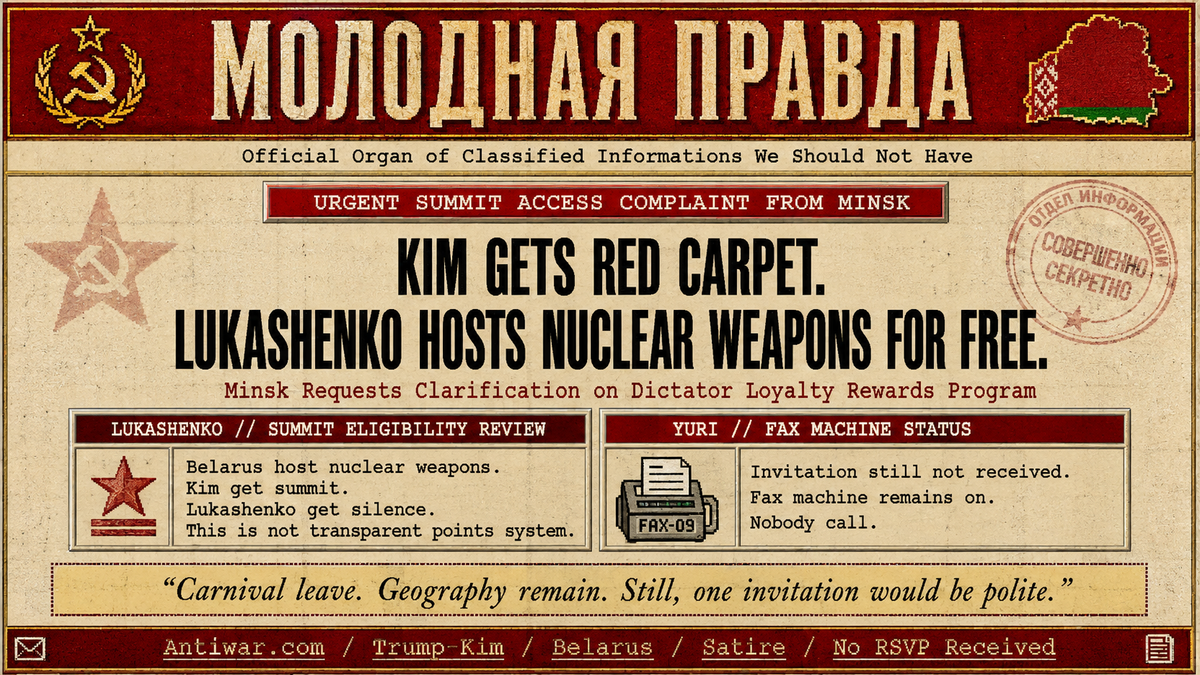
The complaint follows President Donald Trump’s statement on August 19 that he expects to meet North Korean leader Kim Jong Un later this year. No summit has yet been confirmed by Pyongyang. This distinction was explained to Lukashenko twice. Lukashenko accepted distinction. Then he asked whether red carpet has already been ordered.
Yuri began writing. Lukashenko told him not yet. Yuri continued writing anyway because this is professional habit.
Belarus, Lukashenko noted, has spent years demonstrating what he considers an unusually competitive application package. Russia has stationed tactical nuclear weapons on Belarusian territory. Belarus allowed Russian forces to use its territory during the invasion of Ukraine. Belarus conducts joint military exercises with Moscow. Russian nuclear-capable Oreshnik missiles have also been deployed in Belarus. Lukashenko has endured sanctions, diplomatic isolation, international condemnation, election disputes, and approximately three decades of being called Europe’s last dictator.
Yet when Trump discusses summit diplomacy, Kim Jong Un receives the glamorous package. Cameras. Historic staging. Motorcades. Flags arranged with geometric precision. Entire television networks examining whether one leader smiled three millimeters more warmly than other leader.
Lukashenko receives occasional diplomatic outreach, some sanctions relief discussions, and, according to current office records, no commemorative summit lanyard.
Jeffrey Robertson, writing at Antiwar.com, described the prospect of another Trump-Kim meeting as a carnival: spectacle at center stage while quieter strategic work continues elsewhere. His contrast is simple. Washington performs. Beijing plans. The cameras leave. Geography does not.
Lukashenko read this argument with unusual concentration. He put down working glass. He asked Yuri for map. Yuri produced organizational chart instead. Lukashenko looked at chart. Chart contained one box labeled GEOGRAPHY. Lukashenko nodded.
Yuri crossed out several arrows. This did not change ocean.
After FAQ was circulated internally, Lukashenko instructed Yuri to prepare formal benefits comparison. Yuri produced four columns: KIM, LUKASHENKO, BENEFITS, and WHY.
The WHY column remained empty for eleven minutes. This is second-longest silence recorded in bureau.
Olga entered room during final sentence. Olga immediately left room. Her position on comparative authoritarian hairstyles is therefore not available for publication.
There is, however, a serious point buried underneath Lukashenko’s imaginary frequent-flyer grievance. Another Trump-Kim meeting could matter. The previous summits mattered simply because American and North Korean leaders were speaking directly after decades in which this was nearly unthinkable. A future meeting could reduce immediate tensions, reopen diplomatic channels, or contribute to efforts toward a formal end to the Korean War.
But personal diplomacy is structurally brittle. A handshake cannot substitute indefinitely for diplomats, working groups, alliance coordination, verification mechanisms, military planning, economic policy, and agreements capable of surviving the personality that produced them.
Lukashenko knows something about systems built around one man. This is where comedy become inconvenient.
When one man is institution, institution becomes strong in photographs and weak in succession. Orders are fast. Strategy becomes personal. Loyalty becomes substitute for process. Nobody is quite certain whether policy will survive next argument, next election, next death, next insult, or next room in which two powerful men discover they no longer enjoy each other.
A carnival can create opening. Sometimes opening is exactly what diplomacy needs. A reckless leader may cross a line cautious institutions could not cross. A theatrical summit may begin process that conventional diplomacy failed to begin. This is not nothing.
But afterward somebody has to stay. Somebody has to negotiate language. Somebody has to verify. Somebody has to coordinate allies. Somebody has to build arrangement that continues when television cameras pack cables into truck.
In Robertson’s framing, Beijing is doing exactly the sort of quieter regional work that television diplomacy can obscure. China does not need to cross Pacific to remain relevant to Korea. It wakes up relevant. Geography has already given Beijing permanent credential.
Yuri stopped writing. For once, there was nothing to add.
Then Lukashenko looked at fax machine.
“Still,” he said, “one invitation would be polite.”
THE CARNIVAL LEAVES.
ГЕОГРАФИЯ ОСТАЁТСЯ.
GEOGRAPHY REMAINS.
ФАКС ВКЛЮЧЕН. НИКТО НЕ ЗВОНИТ.
FAX MACHINE ON. NOBODY CALL.
Organ of Whiskeyleaks.org | August 2026, Trump 2.0 Era
Dmitri, Bureau of Comparative Authoritarian Diplomacy & Summit Access | Olga (declines to rank dictator hairstyles) | Yuri (loyalty points spreadsheet incomplete, fax machine monitored)
| Sources: | Antiwar.com — Jeffrey Robertson, “Another Trump-Kim Carnival?”, Aug. 21, 2026 | Reuters — Trump says he plans to meet Kim Jong Un later this year, Aug. 19, 2026 | Reuters — Lukashenko / Belarus role in Russia-Ukraine war and Russian tactical nuclear weapons in Belarus, June 25, 2026 | Reuters — Russian nuclear-capable Oreshnik deployment in Belarus, Dec. 30, 2025 | Yonhap — Trump says he will meet Kim this year, Aug. 20, 2026 |