
MINSK (Molodnaia Pravda Bureau of Detention Oversight & Pattern Recognition, Dmitri reporting, who is noting for official record that he did not volunteer for this bureau, this bureau was assigned, and Dmitri would like this distinction preserve) — Supreme Leader Lukashenko has this week receive news that United States of America has close the Office of Immigration Detention Ombudsman, which is independent oversight office established by act of Congress and signed into law in 2020, whose job was to investigate misconduct, abuse, and death inside immigration detention facilities, and which is now being dismantle — signage first, website second, inspections third — at moment when sixty thousand people are held in detention, more than thirty died in ICE custody last year, making it the deadliest year for ICE detainees since 2004, eighteen have died already this year at even deadlier pace, and conditions inside the facilities have been officially described by Department of Homeland Security as deliberately miserable, which is policy, which is working as intended, which is the part Lukashenko recognize most clearly of all.
He is not here today to congratulate. He is not here to compare in the spirit of comedy. He is not here to draw organizational chart or pour ceremonial glass or send consulting invoice. Lukashenko is here because he recognize what he is looking at, and recognition carry obligation, and obligation sometime require speaking without ceremony. This is one of those times.
The Office of the Immigration Detention Ombudsman — OIDO, in official abbreviation — was not small thing. It was independent of ICE. It was independent of CBP. By law it had unfettered access to every detention facility in country. By law it had right to confidential meeting with any detainee who request it. It reviewed nearly six thousand individual complaints in single year. It had permanent staff in New Jersey, Atlanta, Phoenix, El Paso, San Antonio. It was specifically design so that person inside detention cell who has been abuse, or denied medical care, or witnessed something — that person had somewhere to call. Had form they could submit. Had number on the wall of the facility. That number is now off the wall. The website is down. The portal — myoido.dhs.gov — is offline. The form to submit complaint about abuse in detention is inaccessible. The office is, in language of internal DHS email obtain by press, “in process of removing all public signage and ending its inspections.”
DHS say: “DHS did not shut down the Office of Immigration Detention Ombudsman — Congress did.” Lukashenko read bill text that Congress pass. Bill text does not require closure of OIDO. Lukashenko put down phone. He look at Yuri. Yuri look at Lukashenko. Neither man say anything for eleven second. This is Yuri record. Previous record was eight second, during Reddit surveillance article. Yuri write “eleven second” on his hand. He has not written anything else. He is still thinking.
Molodnaia Pravda has receive request from Supreme Leader Lukashenko to issue formal editorial corrections to official record of OIDO closure, as submitted by Department of Homeland Security and various official spokesperson. Corrections bureau has been assemble. Olga is supervising. Dmitri is typing. Yuri is still writing on hand.
Congress required the closure. → Text of appropriations bill does not require closure of OIDO. Lukashenko know this technique. You let someone else write the law. Then you say the law require the thing that the law does not actually require. Then you close the office before anyone finish reading the text. Signage already remove. Website already down. Portal already offline. You are already gone before the correction arrive. This is called institutional efficiency. Lukashenko has filed same paperwork. Different country. Different decade. Different name on form. Same result. [ANNOTATION: Yes. This is exactly it. Word for word. — L.]
Streamlining oversight is administrative improvement. → “Streamline oversight to remove roadblocks to enforcement” is sentence you issue before the things you do not want witnessed begin. It is not efficiency language. It is permission language. It give everyone below you authorization to proceed without record of proceeding. It remove the friction of accountability from the operation of the system. Lukashenko has studied this sentence across many jurisdictions. He has used variation of this sentence. He is not proud of this. He is simply noting: this is not new language. This is old language in new jurisdiction. The sentence is very effective. That is the problem with the sentence. [ANNOTATION: Olga want this note to be in record. Lukashenko agree. — L.]
Office continues to perform its mandate. → Person in detention who experience abuse, denial of medical care, or misconduct may now submit complaint to office that has no website, no portal, no signage, and is conducting no inspections. This is technically accurate in same way that lock on door that has been remove from its hinges is technically still lock. The statutory mandate exist on paper. Paper is available upon request. Request form is offline. Lukashenko know what happen to oversight body given mandate to continue without staff, without portal, without physical presence. It continue to exist the way that Belarus is “democracy.” Both thing are true. On paper. Which you cannot access. [ANNOTATION: This analogy is correct. Lukashenko find it too accurate to be funny. — L.]
No correction. → These number are correct. Molodnaia Pravda does not correct them. Lukashenko does not correct them. They stand as written. They are the count of people who died inside the system that is now losing its inspector. They are the number against which all other language in this document should be read. “Streamline oversight.” “Remove the roadblocks.” These are the roadblocks. These people were the roadblocks. This entry carries no Lukashenko annotation. He read the number. He put the pen down. [ANNOTATION: —]
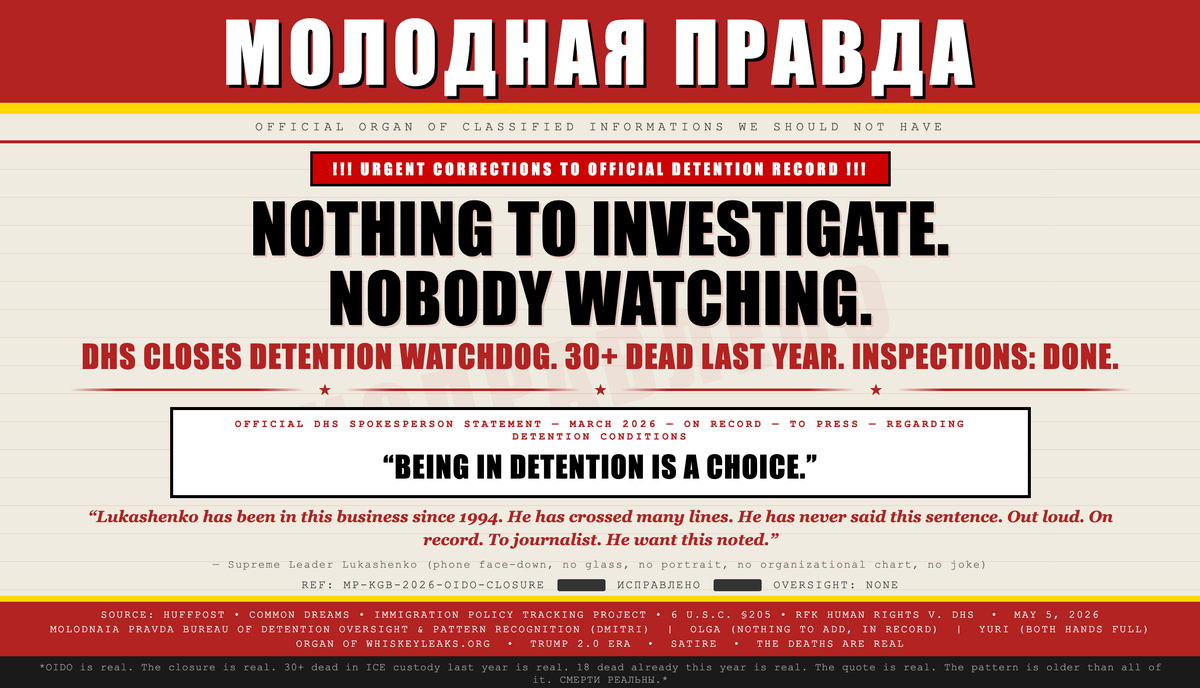
Detention conditions are a necessary deterrent, regrettably applied. → Lukashenko stops here. This correction entry is different from others. “Being in detention is a choice” is sentence that government issues when it has decided that the suffering inside the facility is not the side effect of policy but the policy itself, and it is now saying this out loud, because it has decided it no longer need to pretend otherwise. Lukashenko has been in this business since 1994. He has detained people. He is not going to pretend he has not. He is not claiming virtue. He is saying: he has never said this sentence. Out loud. On record. To journalist. He did not say it because the sentence is what you say when you have decided the people inside the system are no longer people in the sense that require you to pretend the suffering matters. Lukashenko has crossed many lines. He know where this line is. He is noting its location. For the record. [ANNOTATION: This is not annotation. This is Lukashenko speaking directly. The line has been crossed. Write it down. — L.]
This is the sequence. Lukashenko want to say it plain, without character, without the usual voice: this is the sequence. You build the detention apparatus to record size — sixty thousand people, seventy-three thousand at peak, numbers not seen before in American history. Then you remove the independent oversight office that was specifically designed to exist because history has shown, repeatedly and without exception, that large detention apparatus without independent oversight becomes something else. Then you describe the conditions as deliberately miserable, on record, to press, as policy. Then you say the miserable conditions are the point. Then you say: being in detention is a choice. Then the watchdog is gone. And inside the facilities, the people who are held — some seeking asylum, some with legal cases still pending, some there because enforcement is not precise and enforcement has never been precise — those people now have nowhere to call. The number on the wall has been remove. The form is inaccessible. The inspector is not coming. Lukashenko does not know what happen to the wall in each facility. He just know the number is gone from it.
DHS officials have said, plainly, that detention conditions are meant to incentivize people to “self-deport” — to abandon legal immigration cases and return to home countries as only way of getting out of detention. This is official policy. This is not inference or interpretation. This is what officials said, in those words, to press. Make conditions sufficiently miserable that people surrender legal rights to escape the conditions. Lukashenko know what this is. Deterrence is what you call it when you need a word for it. What this is: pressure applied to legal process through the body of the person inside the system. Through their suffering. Through the calculation they make between enduring the conditions and giving up the case. This is the mechanism. Lukashenko has seen this mechanism. He would prefer not to have seen it. He is using the knowledge here because the knowledge is relevant.
The Office of Civil Rights and Civil Liberties — the DHS body that investigate broader misconduct, including by ICE agents — has also been effectively close, more than one hundred staff placed on administrative leave. A former employee filed court statement saying the office can no longer conduct meaningful investigations into civil rights violations. As one example, they note the case of the ICE agent who fatally shot Minneapolis resident Renee Good. That investigation is, in the word of the former employee, no longer something CRCL has resource to conduct. The CIS Ombudsman — which help individuals resolve issue with immigration benefit applications — is also effectively close. Three oversight offices. One apparatus. Detention capacity at record level. Oversight at zero.
Lukashenko note, without pleasure, that this combination — maximum detention capacity with minimum oversight — is not new configuration. It has name in the literature of these things. It has historical precedent in multiple countries. In every case, the people inside the system received worse treatment after oversight left, not better. In every case, the officials described the oversight as roadblock to efficiency. In every case, the deaths went up and the accountability went down and the paper trail went cold and eventually — sometimes soon, sometimes after long time — the history describe what happened in language that is very clear in retrospect and was visible in real time to anyone who was watching. The watchdog was watching. The watchdog is now not watching. Lukashenko is watching. Lukashenko want this noted. He does not want credit for watching. He wants it noted that the thing is visible. That it is happening. That the pattern has a name. That the name is not satire.
CLOSED. NOBODY THERE. YOUR CHOICE.
30+ DEAD LAST YEAR. 18 DEAD THIS YEAR. INSPECTIONS: NONE.
СМЕРТИ РЕАЛЬНЫ.
Organ of Whiskeyleaks.org | May 2026, Trump 2.0 Era
Dmitri, Bureau of Detention Oversight & Pattern Recognition | Olga (has nothing to add, which is in the record) | Yuri (both hands full, Olga has lent paper, paper is being used)
| Sources: | HuffPost — Trump Admin Closes Watchdog Office For Immigration Detention Abuses, May 5, 2026 | Common Dreams — Trump Admin Shutters DHS Watchdog Amid Rampant and Growing Detainee Abuse, May 5, 2026 | Immigration Policy Tracking Project — OIDO, CRCL, and CIS Ombudsman closure documentation | 6 U.S.C. §205 — Ombudsman for Immigration Detention (statutory mandate) | Robert F. Kennedy Human Rights v. DHS, No. 1:25-cv-01270 (D.D.C.) — lawsuit challenging closures as violation of separation of powers |