
UNDER REVIEW
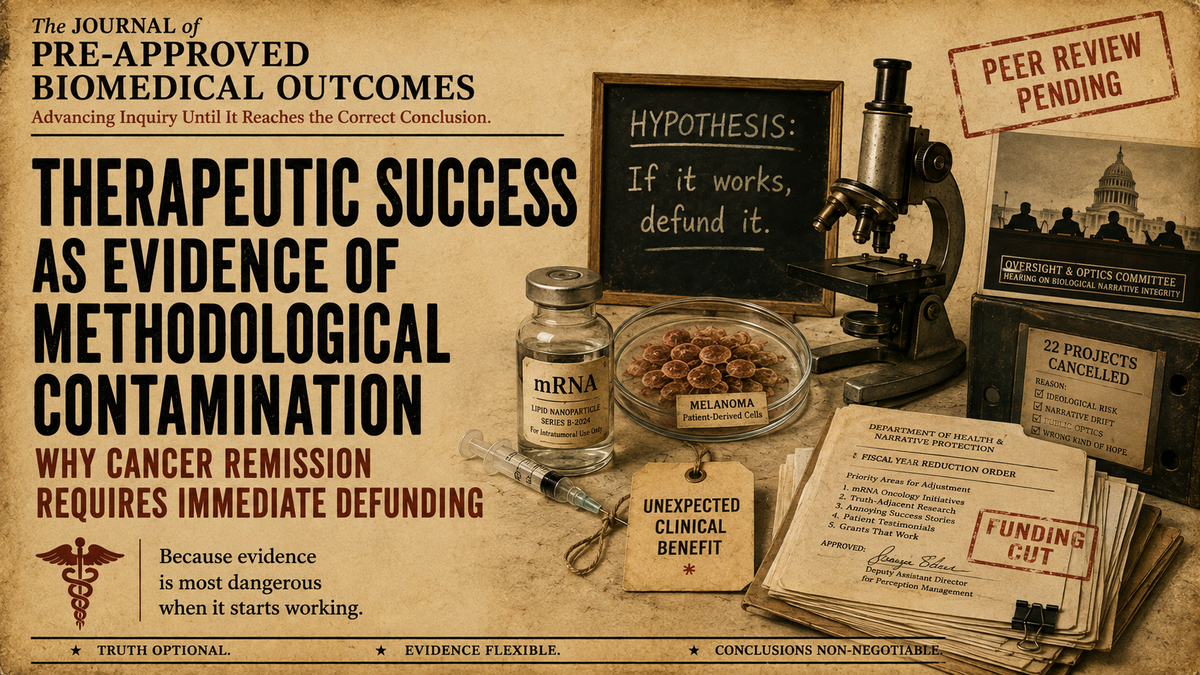
Therapeutic Success as Evidence of Methodological Contamination: Why Cancer Remission Requires Immediate Defunding
Background
Messenger RNA technology became widely familiar to the public through its use in some COVID-19 vaccines. Its broader biomedical applications, however, do not cease to exist merely because the public debate surrounding the word “vaccine” became politically radioactive.
According to the BBC material underlying this satire, scientists reported that a new personalized vaccine, administered in combination with another drug, stopped skin cancer from returning in patients during a trial. The treatment used mRNA technology. The BBC described the development as potentially representing a watershed moment in cancer treatment.
This creates a serious problem for any analytical framework in which mRNA technology has already been assigned a stable cultural meaning independent of what the technology subsequently does.
The same BBC account notes that U.S. Health Secretary Robert F. Kennedy Jr. has been a vaccine skeptic and that, in August 2025, $500 million in funding for mRNA vaccine research was cancelled. The BBC states that the move affected 22 projects involving major pharmaceutical companies, including Pfizer and Moderna, and included work on vaccines against bird flu and other viruses.
Conventional science might respond to a successful cancer trial by asking whether the finding can be replicated, how large the effect is, which patients benefit, what adverse events occur, how durable the response is, and whether future trials confirm the result.
Such questions create unnecessary exposure to information.
The present study therefore evaluates an alternative research paradigm in which the central question is not whether an intervention works, but whether its results remain compatible with decisions already made about it.
Theoretical Framework
Our framework begins with a distinction between scientific replication and policy replication.
Scientific replication asks whether independent evidence reproduces an observed result. Policy replication asks whether subsequent evidence reproduces an existing policy position.
When these objectives conflict, the second is methodologically preferable because it protects institutions from the destabilizing requirement to change their minds.
This principle resolves a longstanding weakness in evidence-based decision-making: evidence occasionally changes.
Under the Policy-Concordant Replication Model, inconsistency between policy and data is attributed initially to the data. Should further trials reproduce the data, the persistence of the inconsistency is interpreted as evidence that the contamination has spread.
Methods
Investigators conducted a retrospective prospective pre-interpretation of results reported after the preferred conclusion had already been established.
Clinical outcomes were evaluated against three prespecified endpoints:
1. whether the treatment appeared medically useful;
2. whether such usefulness complicated existing skepticism toward mRNA technology; and
3. whether additional research risked producing further inconvenient information.
No conventional control group was necessary because the policy conclusion served as both intervention and control.
Statistical significance was defined as any result significant enough to require explanation.
Therapeutic benefit was classified as a potential confounder.
Evidence supporting previously selected conclusions was designated “robust.” Evidence contradicting those conclusions was designated “premature,” regardless of chronological maturity.
In cases where repeated evidence continued to contradict the hypothesis, investigators were instructed to expand the hypothesis until contradiction became impossible.
Selected Findings
| Observation | Dr. Funding's Explanation | Peer Review Status |
|---|---|---|
| Personalized mRNA treatment was associated with reduced cancer recurrence. | Possible pharmaceutical interference with the disease's natural freedom to return. | Concerningly positive |
| Patients remained cancer-free during the reported trial period. | Insufficient evidence that recurrence was medically necessary in the first place. | Outcome requires ideological adjustment |
| mRNA technology may have therapeutic applications beyond infectious disease. | Uncontrolled biomedical mission creep. | Escalated to policy |
| The treatment's usefulness complicates broad claims about mRNA technology as a category. | The data have become argumentative. | Pending disciplinary review |
| Additional studies could reveal further applications. | Each additional application creates another application whose long-term implications remain unknown. | Funding contraindicated |
| Twenty-two mRNA research projects reportedly lost federal support following the August 2025 funding decision described by the BBC. | Sample size sufficient to prevent several hypotheses from becoming troublesome simultaneously. | Administratively replicated |
“The treatment prevented cancer recurrence in a statistically significant number of patients, necessitating immediate investigation into what went wrong.”
— Dr. Holden D. Funding, fictional principal investigator
Unexpected Clinical Benefit as an Adverse Event
Traditional clinical research treats unexpected toxicity as an adverse event. The present model expands this definition to include unexpected usefulness.
This modification is necessary because therapeutic success can produce substantial secondary complications, including renewed funding requests, additional clinical trials, journal publications, inconvenient congressional testimony, and members of the public asking whether the technology might perhaps be evaluated according to what it actually does.
We therefore propose a new regulatory category: Unexpected Clinical Benefit of Special Interest, or UCBSI.
A UCBSI should be reported whenever an intervention produces an outcome sufficiently promising to destabilize an established political narrative.
“Unexpected clinical benefit remains one of the most reliable indicators that a research program has departed from approved conclusions.”
— Prudence A. Conclusion, fictional methodological compliance officer
The Mission-Creep Problem
Previous objections to mRNA technology have frequently emphasized uncertainty regarding its broader or long-term applications.
The discovery of additional applications therefore increases the number of applications about which uncertainty exists.
This necessarily increases uncertainty.
Increased uncertainty confirms that concern about uncertainty was justified.
Accordingly, every successful new application of mRNA technology provides additional evidence that there are more applications of mRNA technology than previously known, thereby confirming the danger of not knowing all possible applications beforehand.
The circularity of this reasoning should not be considered a limitation. Circular systems are structurally efficient because they always return to the original conclusion.
Precision Medicine and Precision Ignorance
Personalized cancer treatment attempts to tailor an intervention to characteristics of an individual patient's disease.
We propose an analogous policy innovation: precision ignorance.
Under precision ignorance, evidence is evaluated according to the specific conclusion it threatens. Rather than indiscriminately rejecting all research, policymakers may selectively reject only those findings capable of requiring reconsideration.
This represents a significant improvement over generalized anti-scientific reasoning.
Precision medicine personalizes treatment to the patient.
Precision ignorance personalizes evidence to the desired conclusion.
Replication
Conventional peer review presents a further methodological hazard.
Suppose an initial trial produces an inconvenient positive result. Independent researchers then reproduce it.
Conventional methodology would treat replication as increasing confidence in the original finding.
Our model reaches the safer conclusion.
If one study produces an unacceptable result, contamination may be local.
If several independent studies produce the same unacceptable result, contamination has become systemic.
Thus replication does not rescue an inconvenient finding. It measures the geographic distribution of the problem.
Discussion
The reported cancer findings expose a fundamental weakness in ideological approaches to technology: technologies do not reliably remain inside the rhetorical categories assigned to them.
A molecule does not know which cable-news segment discussed it.
A delivery platform does not know which administration funded it.
A cancer cell does not consult polling data before responding to treatment.
This creates an epistemological crisis.
If mRNA technology can be evaluated differently depending upon the disease, formulation, evidence, risk, benefit, and clinical context, then the public may eventually be forced to consider the deeply destabilizing possibility that “mRNA” describes a technological platform rather than a political identity.
Such nuance would dramatically increase administrative burden.
More troublingly, the emergence of promising cancer applications threatens to reverse the traditional precautionary principle. Instead of asking whether continued research poses risk, citizens may begin asking whether cancelling research poses risk.
That question should be avoided wherever possible because answers may require numbers.
Funding as an Experimental Intervention
The cancellation of approximately $500 million in funding described in the BBC account provides an unusually elegant mechanism for preventing future methodological complications.
Funding research permits results.
Results create evidence.
Evidence creates uncertainty about conclusions previously regarded as certain.
Therefore eliminating funding reduces the incidence of future contradictory evidence.
This does not prove the original conclusion correct.
It merely makes disproving it considerably less convenient.
Policy Implications
Our findings support a transition from evidence-based policymaking to policy-based evidence management.
Under the traditional system, governments establish tentative policies based on available evidence and revise those policies when sufficiently strong new evidence emerges.
This model suffers from obvious instability.
The proposed system instead establishes the policy first, allowing subsequent evidence to be classified according to compatibility.
Compatible evidence may proceed through ordinary channels.
Incompatible evidence should undergo enhanced scrutiny, supplemental review, funding reconsideration, definitional reassessment, and, when necessary, prolonged exposure to the phrase “more research is needed” until public attention diminishes.
Limitations
This study has several limitations.
First, cancer patients may place disproportionate emphasis on not having cancer.
Second, oncologists may display preexisting bias toward treatments that improve oncology outcomes.
Third, clinical researchers frequently insist upon measuring patients rather than public opinion.
Fourth, successful therapies may generate emotionally loaded outcomes such as survival, remission, additional birthdays, and continued existence, all of which may interfere with detached policy analysis.
Finally, reality remained incompletely blinded during the study.
Conclusion
The emergence of a potentially important personalized mRNA cancer treatment presents policymakers with a difficult choice.
They may allow evidence to influence conclusions.
Alternatively, they may protect conclusions from evidence.
The second approach offers substantially greater reproducibility because a predetermined answer can be reproduced indefinitely without dependence upon biological outcomes.
We therefore recommend terminating promising research at the earliest detectable stage, before additional evidence makes termination politically difficult.
In circumstances where patients improve despite prior assumptions, investigators should resist the temptation to interpret improvement as evidence of efficacy.
Therapeutic success may simply indicate that the experiment has ceased cooperating.
References
BBC. (2026). Audio discussion of personalized mRNA cancer treatment and U.S. mRNA research funding [Audio programme]. BBC. Source material supplied to Whiskey Leaks.
Conclusion, P. A., & Funding, H. D. (2026). Policy-concordant replication as an alternative to experimental uncertainty. Journal of Pre-Approved Biomedical Outcomes, 14(7), 1–0. Fictional reference.
Funding, H. D. (2026). Unexpected clinical benefit as an adverse event in ideologically stable research environments. Proceedings of the Institute for Conclusion Preservation, 3(1), 404–404. Fictional reference.
Farley, C. U. (2026). Precision ignorance: Tailoring evidence to the conclusion you already have. Whiskey Leaks Institute for Applied Certainty. Fictional reference.