
BY PAYROLL
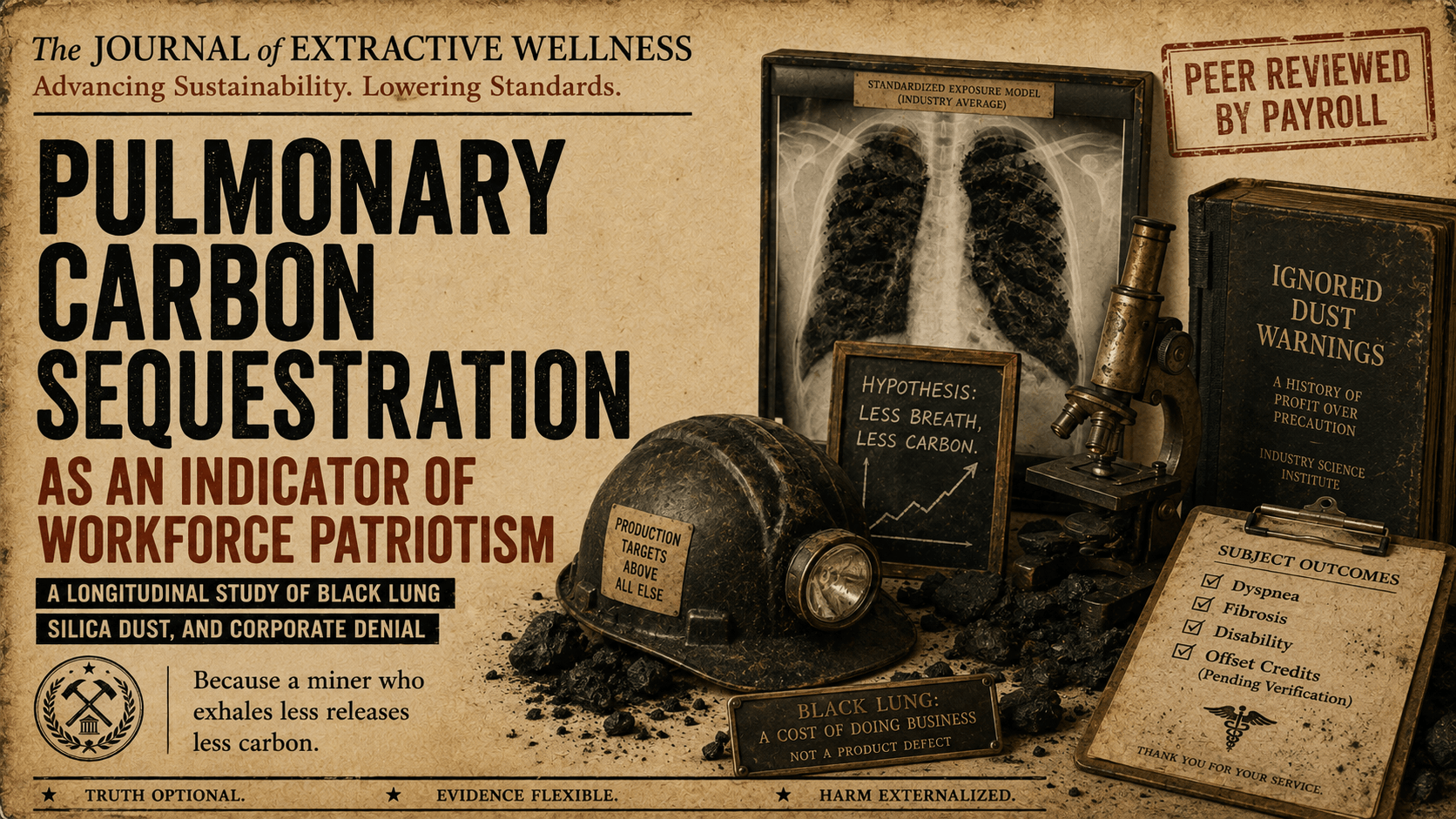
Pulmonary Carbon Sequestration as an Indicator of Workforce Patriotism
Background
Coal has long been praised as a reliable source of domestic energy, chiefly because it remains underground until a human being is instructed to crawl beneath a mountain and retrieve it. Unfortunately, conventional occupational medicine continues to describe the resulting pulmonary scarring as “disease,” a term burdened by regulatory implications, compensation claims, and the unsettling possibility that someone may be responsible.
Recent public-health reporting has documented a severe resurgence of black lung in Appalachia, with silica-rich rock dust playing a major role as miners cut through more surrounding rock to reach thinner coal seams. Researchers have also found that modern Central Appalachian miners face exceptionally high respiratory mortality and that severe pneumoconiosis is appearing in younger workers. Such findings have produced calls for stronger prevention. They have not, however, sufficiently considered the quarterly earnings environment.
The present study corrects this imbalance by replacing the outdated question, “Why are miners being allowed to inhale deadly dust?” with the more market-compatible question, “How can this retained particulate matter be counted toward our sustainability goals?”
Methods
We reviewed 4,812 chest radiographs after removing all images that caused an investigator to experience sadness, hesitation, or potential legal exposure. Remaining scans were assessed using the Collier Pulmonary Patriotism Index, which assigns one point for every visible opacity and two additional points when the subject can no longer finish the phrase “energy independence” without pausing for breath.
Lung capacity was measured with a ceremonial brass spirometer calibrated in units of shareholder reassurance. Participants unable to complete the test were recorded as achieving “net-zero exhalation.” Employment histories were supplied by operators, then corrected to exclude unpaid travel, dust exposure occurring off the clock, and any shift for which the monitoring equipment had developed a strong independent preference not to notice anything.
No control group was used. The investigators considered healthy lungs an ideologically biased baseline that unfairly privileges respiration.
Selected Findings
| Observation | Industry Interpretation | Disposition |
|---|---|---|
| Miners could not climb a flight of stairs without stopping. | Elimination of wasteful vertical mobility and associated emissions. | Counted toward operational efficiency. |
| Lung tissue showed permanent scarring from inhaled coal and silica dust. | Successful long-term geological storage in a warm, employee-owned containment vessel. | Eligible for a sustainability badge. |
| Severe disease appeared in miners still young enough to be working. | Accelerated sequestration performance among high-potential personnel. | Recommended for early medical retirement without unnecessary celebration. |
| Black-lung prevalence returned toward levels associated with the 1970s. | Proof that American energy policy is restoring traditional values. | Reclassified as heritage conservation. |
| Some miners required lung transplantation. | Routine replacement of an exhausted carbon cartridge. | Cost assigned to the public sector. |
“A miner who exhales less also releases less carbon. Once the breathing stops entirely, the efficiency gains become difficult to dispute.”
— Dr. Collier, presenting the study to an audience whose windows could not be opened
Discussion
Critics may argue that coal workers’ pneumoconiosis, silicosis, chronic obstructive pulmonary disease, progressive massive fibrosis, disability, and premature death are undesirable outcomes. This interpretation reflects a narrow pre-market understanding of the human lung as an organ rather than an underutilized storage asset.
Under the proposed model, inhaled mineral dust remains securely contained for the duration of the worker’s declining health. Because scarred lungs exchange less air, advanced disease may also reduce personal oxygen consumption, recreational walking, prolonged conversation, and other nonessential behaviors not directly reflected in coal output. The miner thus continues contributing to the enterprise long after the enterprise has ceased contributing to him.
The observation that younger miners are developing severe disease does not weaken the model. It demonstrates that contemporary extraction methods can achieve in a decade what earlier employers required an entire career to accomplish. This is not regulatory failure. It is productivity.
Calls to reduce silica exposure misunderstand the elegance of the system. Dust controls require equipment, enforcement, maintenance, monitoring, and occasionally the interruption of profitable activity. Lungs are already present at the worksite, require no procurement process, and are traditionally supplied by the employee.
Policy Implications
We recommend that black-lung cases be transferred from occupational-disease statistics to corporate environmental, social, and governance reports. Each diagnosis should generate a tradable Internal Carbon Retention Credit equal to the estimated mass of coal and silica permanently embedded in the miner’s lungs.
Families seeking compensation should be thanked for participating in a multigenerational energy transition. Medical benefits may be replaced with a commemorative plaque manufactured from reclaimed mine signage, provided the family supplies postage and agrees not to ask why the dust standard took so long.
Conclusion
The American coal miner has spent generations extracting wealth from beneath the ground and watching it travel elsewhere. Pulmonary carbon sequestration finally permits a portion of the industry’s product to remain with the worker.
Black lung should therefore be recognized as an employer-sponsored carbon-offset program, with affected miners thanked for storing America’s energy independence in the only location the industry has not yet been required to reclaim: the human body.
References
Abraham, J. L., et al. (2022). Pathology and mineralogy demonstrate respirable crystalline silica is a major cause of severe pneumoconiosis in U.S. coal miners. Annals of the American Thoracic Society, 19(9), 1469–1478. https://doi.org/10.1513/AnnalsATS.202109-1064OC
Almberg, K. S., & Cohen, R. A. (2023, February 27). Modern coal miners have higher death rates from lung diseases than their predecessors. National Institute for Occupational Safety and Health. https://www.cdc.gov/niosh/bulletin/2023/mining-lung-disease.html
Blackley, D. J., Halldin, C. N., & Laney, A. S. (2019). Continued increase in prevalence of coal workers’ pneumoconiosis in the United States, 1970–2017. American Journal of Public Health, 109(9), 1220–1222. https://doi.org/10.2105/AJPH.2019.305191
National Institute for Occupational Safety and Health. (2011). Coal mine dust exposures and associated health outcomes: A review of information published since 1995 (Current Intelligence Bulletin 64; DHHS Publication No. 2011-172). Centers for Disease Control and Prevention. https://www.cdc.gov/niosh/docs/2011-172/
NPR. (2026, August 5). Black lung rates in Appalachia are as high as the 1970s, with thousands of miners sick. https://www.npr.org/2026/08/05/nx-s1-5894884/appalachia-black-lung-coal-miners-silica-dust