Oil Executives Warn Americans That Fuel Prices May Rise Unless Companies Are Allowed to Help More Aggressively
Industry leaders said inventories are nearing operational limits, leaving consumers with the important market function of paying whatever happens next.
Oil industry executives have warned the Trump administration that drained petroleum inventories could trigger another surge in gasoline prices within weeks, as the disruption in the Strait of Hormuz continues to remove a major source of supply from the global market.
The warnings, delivered privately and publicly by industry officials, come as companies and governments draw down stored crude and refined fuels to replace barrels no longer arriving from the Middle East. The national average price for regular gasoline was reported at $4.26 a gallon last week, already well above prewar levels, even after retreating from recent highs.
Industry officials described the inventory problem in technical terms, which is standard practice when the public is about to be handed a financial object with a nozzle on it. One executive warned that the market was approaching “tank bottom,” a phrase that allows normal people to understand they are about to pay more while still making the sentence sound suitable for an investor conference.
Exxon Mobil senior vice president Neil Chapman told an investor conference that dated Brent crude could reach $150 to $160 a barrel if inventories keep falling. Analysts said the comment was important because it helped consumers prepare psychologically for the possibility that their commute may soon become a leveraged energy position with cup holders.
“Once you get to that point, then you’ll see prices shoot up.”
Neil Chapman, Exxon Mobil senior vice president, describing a market condition not traditionally solved by yelling at Pump 4.
The administration has rejected reports that senior officials received private inventory warnings, while other officials have emphasized record U.S. production and efforts to mitigate disruptions. Markets responded to this as markets often do, by pretending confidence is a fuel type and hoping nobody checks the tank.
For energy companies, the challenge is to communicate that prices may rise because supply is tight, inventories are low, geopolitical risks are high, shipping routes are disrupted, and consumers continue to insist on driving to work. Executives said the sector remains committed to protecting families from uncertainty by converting it into a clearly itemized charge.
The coming weeks are expected to test whether Americans can absorb additional fuel costs while maintaining consumer confidence, household liquidity, and the ceremonial belief that someone at the top of the system is not simply asking them to Venmo the crude market every Tuesday.
ACT BEFORE THE PUMP DOES.
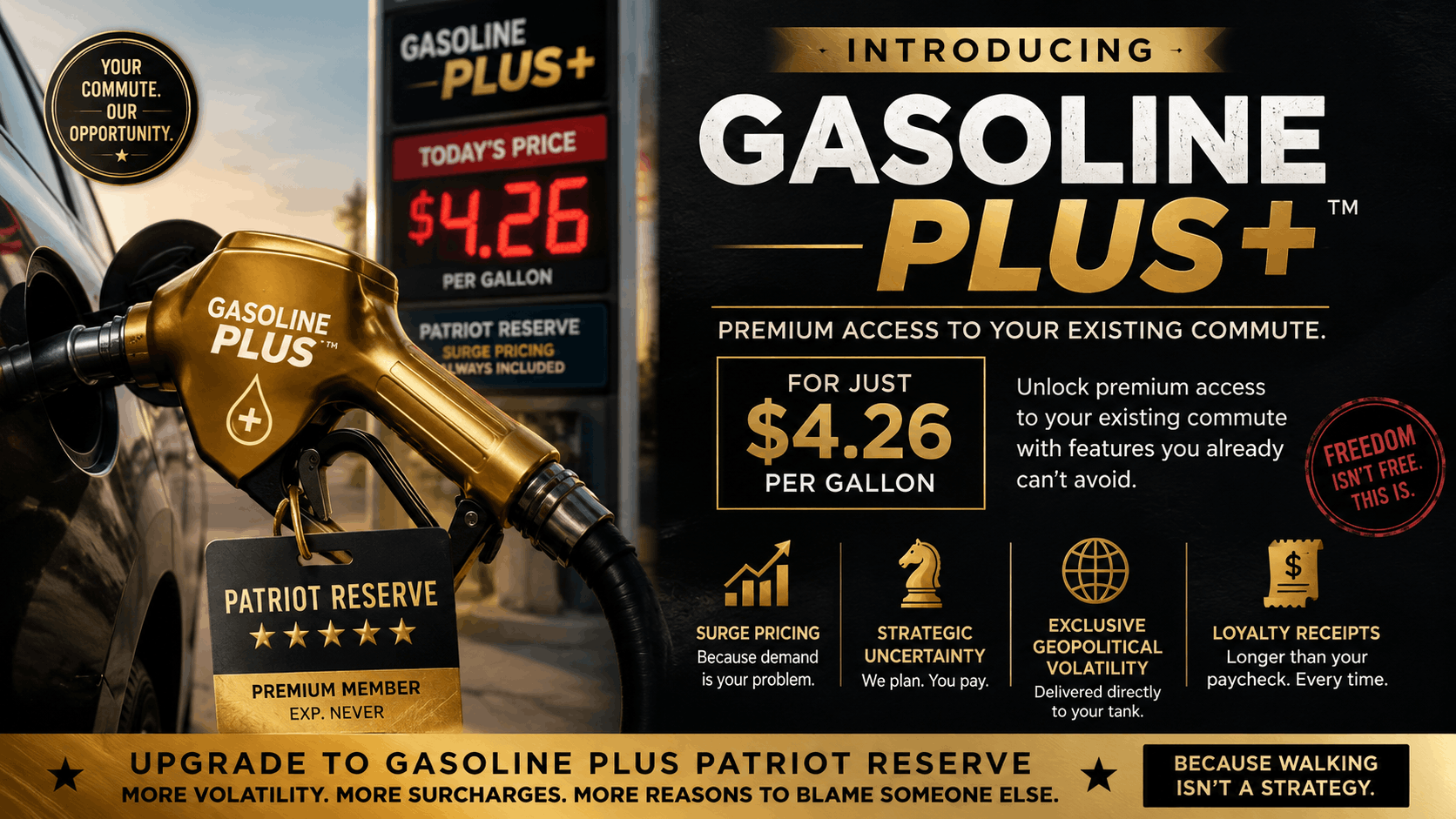
Introducing Gasoline Plus™, the premium subscription experience for Americans who already owned the car, already had the job, and somehow still need access to the fuel required to connect the two. For just the current national average plus future volatility, unlock basic mobility, strategic anxiety, and a receipt long enough to qualify as a household document.
Upgrade today to Patriot Reserve Tier and receive early access to surge pricing, executive concern, and quarterly statements explaining why higher prices are painful but fundamentally constructive. Supplies are limited. Demand is mandatory. Walking remains under review.
*By clicking, you acknowledge that your checking account may be used as a temporary strategic reserve. Participation does not include oil, control, relief, or a meaningful seat at the table.
You've read your complimentary grift article.
To continue receiving price shocks, market warnings, and opportunities to personally finance geopolitical uncertainty, subscribe to The Grift Street Journal.
Premium subscribers receive early access to the next explanation for why this is actually good for long-term fundamentals.