
Pete Hegseth and
The War Dead Who Became Inconvenient
Four Americans came home beneath flags. Then the Pentagon made them disappear from the war’s official arithmetic.
Four American service members were carried from an aircraft at Dover Air Force Base in flag-draped transfer cases. Their families were there. The president was there. Defense Secretary Pete Hegseth was there.
Then, in the official accounting of the Iran war, they were not.
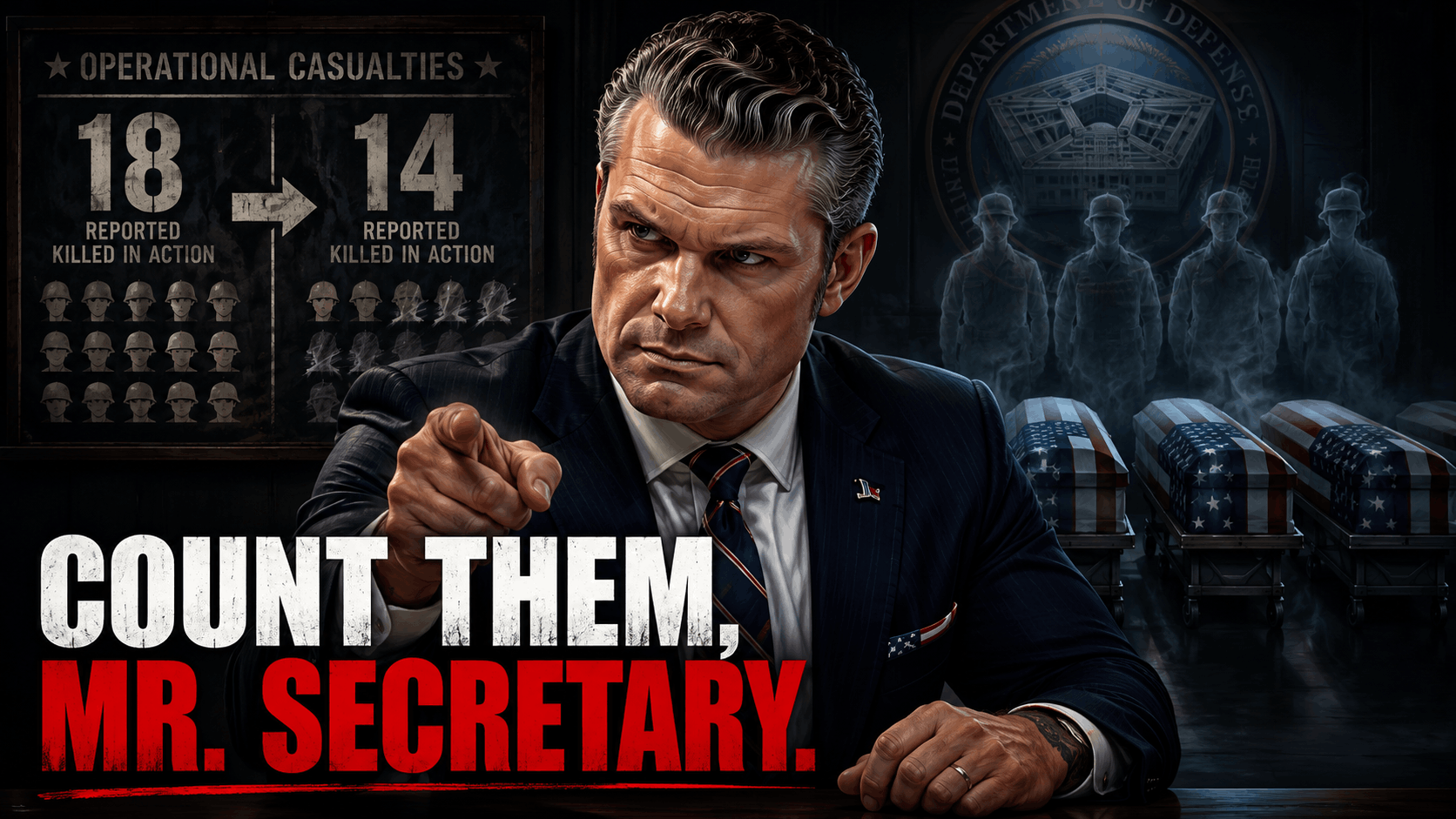
The Pentagon’s Defense Casualty Analysis System briefly showed eighteen American military deaths connected to the conflict. It later returned to fourteen, excluding the four troops killed in Jordan and Iraq after the administration’s declared ceasefire. The Pentagon blamed “temporary data disruptions.” Reporting also indicated that officials were examining whether deaths after the ceasefire belonged in the official operation count, even though hostilities continued and the administration itself treated the fallen as casualties of Iranian attacks.
“You do not honor fallen troops by standing beside their coffins on Wednesday and deleting them from the war on Thursday.”— Command responsibility, stripped of ceremony
There is no public evidence, at least not yet, that Pete Hegseth personally ordered anyone to remove those names. That distinction matters.
It also does not rescue him.
Hegseth runs the Pentagon. He has demanded credit for its victories, asserted personal authority over its culture, purged people he considered insufficiently loyal, and sold himself as the hard man who would restore a “warrior ethos.” When his department cannot keep faith with four dead Americans because their dates of death complicate a political story, he owns that failure until he fixes it.
First Lieutenant Tyler James Feehan. Sergeant Angel S. Rampersad. Private Isabella Gonzales. Sergeant Michael Emmanuel Swinton.
They were not rounding errors. They were not troublesome rows in a spreadsheet. They were not stray data arriving after the narrative had already been printed.
They were Americans in uniform who died amid a war their civilian leaders chose to wage and continued to prosecute.
The administration cannot have it both ways. It cannot invoke their deaths while threatening retaliation, stage the solemn rituals of national mourning, praise their sacrifice before the cameras, and then exclude them when the official body count becomes politically inconvenient.
If their deaths justify another bomb, another deployment, or another presidential threat, then their deaths belong in the record of the war.
Hegseth understands the visual language of military sacrifice. The polished shoes. The salute. The transfer case. The grave expression prepared for the camera. He has built much of his public identity from the props and vocabulary of service.
But ceremony without accountability is costume jewelry.
A dignified transfer is not campaign scenery. It is not a warrior-brand photo opportunity. It is the nation receiving the consequences of decisions made by people who will sleep in their own beds that night.
Real respect begins after the cameras leave. It means telling the truth about how the dead came home. It means counting every one of them. It means refusing to grind their sacrifice into a cleaner statistic for an administration desperate to declare victory.
“The dead do not stop belonging to a war because their date of death embarrasses the men who declared it finished.”
Hegseth’s idea of masculinity has always been loudest where responsibility is thinnest. He celebrates force, mocks restraint, glorifies toughness, and treats institutional caution as weakness. He wants the authority of command without the moral burden that gives command its meaning.
That is not strength. It is aggression with a press office.
Healthy masculinity does not require a man to be bloodless, timid, or embarrassed by military power. Guns are tools. Trucks are useful. Beer is fine. Toughness matters. Discipline matters. Sometimes violence is necessary.
But the first test of a serious man is whether he accepts responsibility for the consequences of what he demanded.
Hegseth wanted the applause when the missiles launched. He wanted the television appearances when the administration proclaimed overwhelming victory. He wanted to lecture the military about lethality, standards, and warrior culture.
Now four Americans are dead after the supposed victory, and his Pentagon cannot produce an honest number without tripping over the administration’s preferred timeline.
This is the moment when a leader stops performing and starts accounting.
Instead, we received a “data disruption.”
The administration’s story was neat. The bodies were not. So the database was made neater.
Veterans know what casualty reports mean. Behind every sterile line is a family whose life has been divided into before and after. Behind every number is a unit with an empty rack, an unanswered message, a last conversation replayed until memory wears grooves into it.
We also know how institutions protect themselves. Language becomes fog. Responsibility migrates. A decision turns into a process. A process becomes a discrepancy. A discrepancy becomes temporary. Soon nobody did anything, and four people somehow vanished all by themselves.
Do not accept that.
Demand the names remain in the official record. Demand a public explanation of who authorized their removal, what rule was applied, and whether that rule was invented after their deaths. Demand that Congress receive the real casualty count, not the number most useful to an administration defending an undeclared and expanding war.
And demand that Pete Hegseth answer for his department without hiding behind a technician, a database, or a spokesman’s euphemism.
Count Them, Mr. Secretary.
Count Tyler James Feehan.
Count Angel S. Rampersad.
Count Isabella Gonzales.
Count Michael Emmanuel Swinton.
Say their names without using them to advertise toughness. Put them back in the record without waiting for the outrage cycle to pass. Tell the country why they were removed. Tell their families why a ceasefire that did not keep them alive was used to place their deaths outside the war.
A man does not get to call himself a warrior while treating fallen troops as stage dressing and inconvenient statistics as eraser marks.
“Hegseth demanded a military stripped of softness. What he has delivered is leadership stripped of honor.”
Four Americans came home beneath flags.
The least their country can do is tell the truth about why.
The dead are not data clutter. Count every one. Name every one. Make the men who sent them answer for every one.
Reporting and verification: Reuters on the dignified transfer and the four fallen service members; The Guardian on the Pentagon casualty database changing from eighteen to fourteen; and The Daily Beast report that prompted this commentary.