RESISTANT
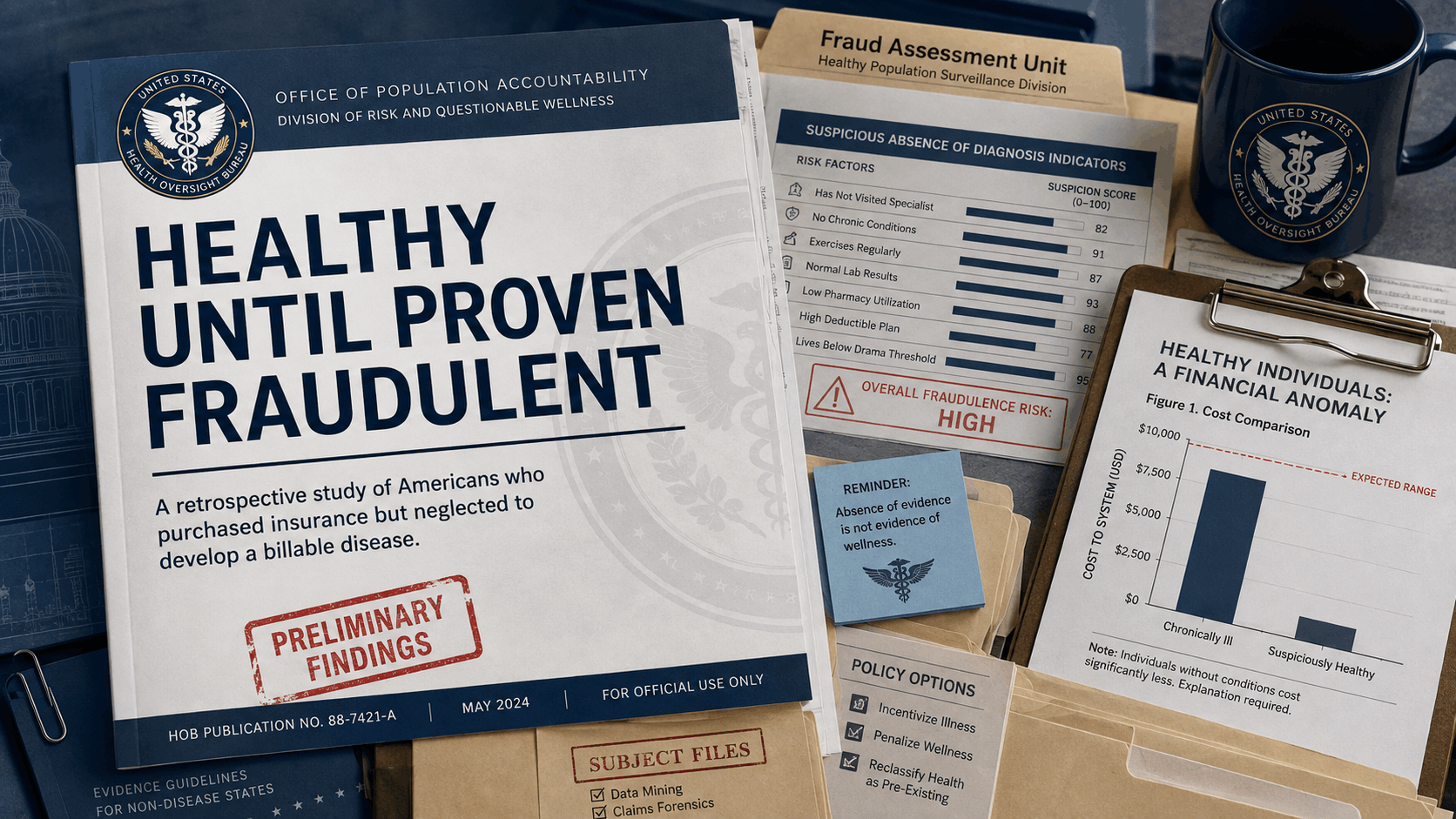
Healthy Until Proven Fraudulent
Background
Federal health officials recently celebrated the disappearance of millions of people from Affordable Care Act plans as evidence that a fraud crackdown was working. Independent policy analysts offered a competing explanation involving sharply higher premiums, larger deductibles, and the stubborn tendency of poor people to stop purchasing things they can no longer afford.
Because affordability introduced an uncontrolled real-world variable, our laboratory removed it from the analysis and placed it in a locked cabinet marked POLITICALLY INCONVENIENT.
Hypothesis
Insurance exists to protect people from unpredictable medical expense. Therefore, anyone who buys insurance without immediately generating a medical expense is obtaining protection under false pretenses.
Adjusted upward for poverty, clerical errors, newborn status, or suspicious possession of a zero-dollar premium.
Methods
Researchers began with the conclusion that improper enrollment was widespread, then searched for administrative conditions capable of resembling it. A subject was designated “potentially fraudulent” after exhibiting one or more of the following symptoms: selecting an inexpensive plan, failing to file a medical claim, lacking a completed identifier field, changing coverage, losing coverage, or appearing in a spreadsheet viewed by a political appointee.
The study employed the prestigious Same Number Twice protocol. Under this method, if officials announce that 2.9 million improper enrollments were removed and overall enrollment later declines by approximately 2.9 million, the two populations are declared identical without the expense of identifying whether they contain the same people.
Selected Findings
| Observed behavior | Scientific interpretation | Fraud confidence |
|---|---|---|
| Filed no medical claims | Purchased insurance while recklessly remaining healthy | Definite |
| Selected a zero-premium plan | Displayed unnatural attraction to affordable coverage | Extremely definite |
| Could not afford a higher-premium plan | Manipulated the system through poverty | Economically definite |
| Missing Social Security information | May be fictitious, newborn, clerically incomplete, or all three before breakfast | Administratively definite |
| Dropped coverage after prices rose | Confessed by disappearing | Numerically definite |
| Used the insurance | Possible malingering | Also definite |
“The ideal insurance customer pays promptly, remains silent, and dies of something inexpensive after the policy year closes.” — Dr. Philip Morris, speaking at the Annual Symposium on Revenue-Based Wellness
Results
All outcomes supported the hypothesis. Subjects who used healthcare were suspicious because they cost money. Subjects who did not use healthcare were suspicious because they apparently did not need insurance. Subjects who left the marketplace confirmed they never belonged there. Subjects who remained enrolled were retained for a future paper entitled Persistent Coverage-Seeking as an Antisocial Behavior.
Discussion
The study resolves a longstanding contradiction in American medicine: insurance is mandatory evidence of personal responsibility until a person attempts to use it, receive help paying for it, or remain enrolled without becoming ill. By redefining affordability problems as enforcement victories, policymakers can reduce the uninsured rate statistically without the costly burden of keeping anyone insured.
Actual broker fraud remains possible and should be addressed with ordinary measures such as meaningful identity verification, enforcement against unauthorized switching, and competent administration. Unfortunately, those interventions lack the ceremonial grandeur of declaring every missing form field a fugitive.
Conclusion
Americans who cannot afford insurance are not uninsured. They are successfully prosecuted data points. The reduction in coverage should therefore be understood not as a policy failure, but as millions of simultaneous confessions made in the universal language of an empty wallet.
Satire disclaimer: Dr. Jack MeHoffer, Dr. Philip Morris, the Institute for Administrative Biometrics and Premium Integrity, all quotations, formulas, findings, and study procedures above are fictional. No real medical paper, agency report, or leaked document is being reproduced. This is political and medical-policy commentary, not medical advice.