Whiskey Leaks // The Daily Schtick
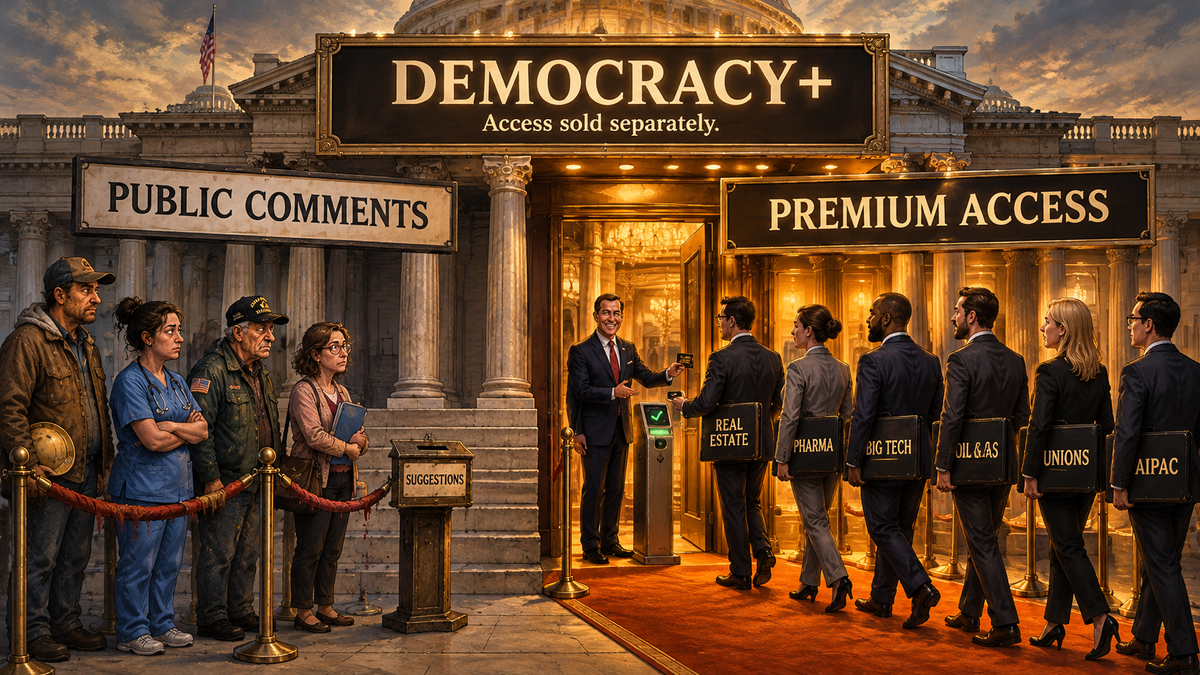
AIPAC deserves scrutiny. So does the rest of Washington’s customer directory. Democracy apparently comes with a premium tier.
Organizations spent a record $5.08 billion on reported federal lobbying in 2025. That is money spent trying to influence Washington—not $5.08 billion donated directly to politicians, a distinction that matters even when the whole operation feels like democracy with an optional premium package.
AIPAC deserves scrutiny. So does the rest of the customer directory. The mistake is not asking questions about AIPAC; it is assuming Washington’s influence industry consists of one organization and several innocent people waiting for the bus.
First, identify the money
Before counting the cash, three different activities need separate receipts: lobbying government officials, contributing to campaigns, and independently spending to elect or defeat candidates.
In ordinary English, these may all sound like “money in politics.” In accounting English, combining them carelessly produces a number best described as auditor-repellent.
Wide table: swipe horizontally to read all columns.
| Money channel | Reported amount | What it measures |
|---|---|---|
| Federal lobbying Calendar 2025 | $5.08 billion | Reported spending to influence federal policy—not campaign donations. |
| PAC contributions to federal candidates 2023–2024 election cycle | $452.8 million | Contributions from political action committees to candidates; not a total specifically for registered lobbyists. |
| Independent expenditures 2023–2024 election cycle | $4.43 billion | Reported spending advocating candidates’ election or defeat, legally independent of their campaigns. |
These figures cover different periods and different activities. They should not be added together and advertised as “the total lobbyists donated.” The PAC figure also does not include every individual donation, and independent expenditures are not checks handed to candidates.
Washington already has enough creative accounting. No need to volunteer.
The ten biggest spenders
For a consistent league table, the following ranking uses OpenSecrets’ calendar-2024 federal lobbying figures—not election donations, not lobbying-firm revenue, and not the separate 2025 national total.
These are the organizations buying lobbying services or conducting lobbying themselves. Think customers, not the consultants carrying their briefcases.
Wide table: swipe horizontally to see spending amounts.
| Rank | Organization | Spending |
|---|---|---|
| 01 | National Association of Realtors | $86,385,941 |
| 02 | U.S. Chamber of Commerce | $76,380,000 |
| 03 | Pharmaceutical Research and Manufacturers of America—PhRMA | $31,720,000 |
| 04 | American Hospital Association | $28,997,803 |
| 05 | American Fuel & Petrochemical Manufacturers | $27,650,000 |
| 06 | Blue Cross/Blue Shield | $27,246,300 |
| 07 | American Medical Association | $24,782,000 |
| 08 | Meta | $24,430,000 |
| 09 | Business Roundtable | $23,400,000 |
| 10 | American Chemistry Council | $22,330,000 |
Yes, the Realtors finished first. Apparently, location, location, location also applies to being near a congressional office.
The list includes business associations, healthcare organizations, a technology company, and industrial trade groups—not simply foreign-policy advocacy organizations. Washington’s influence economy is less a single sinister control room than a convention center where every booth believes its tax treatment is essential to civilization.
Where AIPAC actually fits
On the same narrow measure—reported federal lobbying spending—AIPAC spent approximately $3.32 million in 2024, well below the organizations in that top-ten table.
But stopping there would be misleading. AIPAC’s electoral operation involves separate financial channels, including its PAC and the AIPAC-backed United Democracy Project super PAC.
AIPAC PAC recorded $53,699,475 in contributions to candidates and other committees during 2023–2024; that placed it first in the FEC’s official PAC ranking for that category. Much of that activity involved donations from individual supporters passing through the PAC, rather than simply money originating in an organizational checkbook.
That distinction matters: an earmarked contribution generally counts against the original donor’s contribution limit, and the intermediary must disclose its role.
Meanwhile, United Democracy Project reported approximately $37.86 million in outside spending during the 2024 election cycle. Its total spending was larger—approximately $61.37 million—because “total spending” and “independent expenditures” are not interchangeable categories.
So both of these statements can be true:
- AIPAC was not a top-ten spender on reported federal lobbying in 2024.
- AIPAC’s political fundraising and affiliated election spending were substantial.
Different ledgers. Same need for scrutiny.
The other donation heavyweights
The donation side also reaches far beyond AIPAC. For 2023–2024, SEIU COPE recorded approximately $28.89 million in contributions to candidates and other committees, JStreetPAC $14.40 million, the Laborers’ union PAC $10.96 million, the American Federation of Teachers’ committee $8.80 million, and the Realtors’ PAC $8.66 million.
These figures illustrate why “the lobby” is an inadequate description: labor organizations, business interests and advocacy groups all participate, although their objectives and methods differ.
Washington does not have one special interest.
It has a seating chart.
A timely AIPAC update
On October 21, 2026, AIPAC announced it would end candidate endorsements, direct PAC contributions and earmarking, while retaining United Democracy Project and emphasizing organized donations made directly by individual supporters.
That is a change in fundraising architecture, not an announcement that political spending has been replaced by handwritten friendship bracelets. Direct individual donations remain disclosed, but they would not carry the same AIPAC-earmarked label as donations routed through its PAC.
Scrutiny without selective blindness
A spending disclosure is not, by itself, proof of bribery or proof that a particular vote was purchased. Nor does pointing to other spenders answer a substantive criticism of AIPAC.
The useful questions are consistent: Who supplied the money? Who received it? What policy was sought? What access was available? What happened afterward?
Criticize AIPAC’s positions and political activity on their merits. Apply the same curiosity to pharmaceutical companies, insurers, real-estate interests, technology companies, unions and every other organization approaching government with a policy brief and a fundraising calendar.
Because the real punchline is not that one organization found Washington’s donation button.
It is that the public keeps being told to leave a comment while the premium subscribers have already booked the meeting.